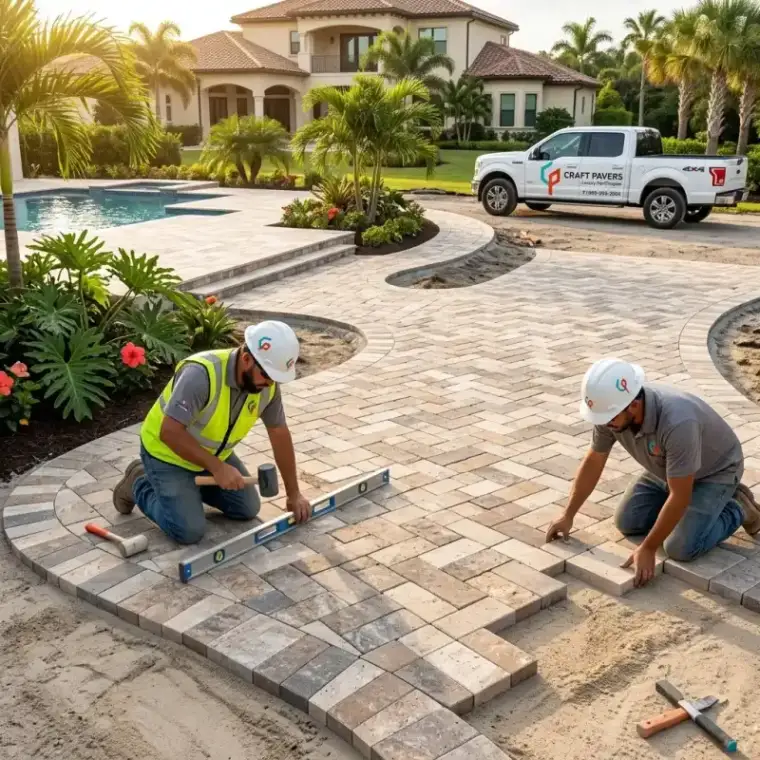
Permeable Paver Installation South Florida
Turfstone, PICP, and eco-grid systems engineered to meet South Florida stormwater requirements — eliminates driveway ponding, satisfies municipal drainage codes, and qualifies for HOA impervious surface exemptions. From $14/sq ft installed.
What Are Permeable Pavers and How Do They Work?
Permeable pavers — also called pervious pavers or permeable pavement — are paving units engineered with open joints, cells, or voids that allow rainwater and stormwater to pass through the surface and into the ground below. Instead of shedding water sideways like traditional pavers, asphalt, or standard concrete, a permeable paver system lets water filter through the surface, infiltrate a stone reservoir base, and slowly release into the underlying layers of soil. This replicates natural hydrology and is one of the most effective on-site stormwater management practices available for residential driveways and patios.
In South Florida — where rainfall exceeds 57 inches per year and municipal drainage systems are already stressed by tropical storms — using permeable pavers on new driveways and patios is increasingly required by code. The pavers help prevent flooding by allowing water to be absorbed on-site rather than adding to storm-drain load. This is the core principle of low impact development (LID), a modern approach to sustainable water management endorsed by the US Environmental Protection Agency (EPA) as a Best Management Practice for stormwater runoff and water quality protection.
Step 1 — Filter
Rainfall hits the paver surface. Water filters through the gravel-filled joints (or open cells) rather than running off across the pavement.
Step 2 — Store
Water enters the 4–8 inch angular crushed stone reservoir beneath the pavers. The reservoir stores stormwater volume from the design storm event.
Step 3 — Infiltrate
Water slowly percolates through geotextile into the underlying sandy soil at the site's natural infiltration rate — recharging groundwater instead of loading storm drains.
Pros and Cons of Permeable Pavers
The honest picture. Permeable pavers solve real drainage and code problems, but they are not a maintenance-free upgrade over traditional pavers.
Pros — Why South Florida Uses Them
- Manage stormwater on-site — no separate drainage system, dry-well, or French drain required
- Satisfy municipal stormwater retention codes and Palm Beach / Broward HOA impervious surface limits
- Eliminate driveway ponding and standing water after Florida's daily summer storms
- Reduce runoff and filter pollutants — protect water quality of surface water bodies and canals
- Recharge groundwater instead of sending rainfall to storm drains
- Reduce heat island effect through subsurface evaporation
- Prevent soil erosion by stopping sheet flow across landscape
- Qualify for LEED credits and Florida Green Building Coalition recognition
- Vehicle-rated systems handle everyday cars, SUVs, and light trucks
Cons — Honest Trade-Offs
- Higher upfront cost — $14–$22/sq ft vs. $12–$18 for standard concrete pavers (stone reservoir base adds $3–$6/sq ft)
- Annual maintenance is required — vacuum joints and top-dress with fresh aggregate to preserve infiltration
- Joint clogging from Florida sand, mulch, and organic debris is the main long-term performance issue
- Not appropriate over impermeable clay or high water table — a percolation test is required on some sites
- Aesthetic range is narrower than traditional pavers — visible gravel or grass fill defines the look
- Weed growth in turfstone or gravel joints needs periodic management
- Pressure washing at high PSI displaces joint fill — requires a different cleaning technique
- Not DIY-friendly — base and joint specifications are engineered, not intuitive
Compare with standard driveway pavers and see our cost-to-install pavers guide for a full material-by-material comparison.
Environmental Benefits & Stormwater Performance
The US Environmental Protection Agency lists permeable pavements — including permeable pavers — as one of the recommended alternatives to traditional pavement under the Clean Water Act's stormwater management practices. In South Florida, where 57–65 inches of annual rainfall meets aging municipal storm drain infrastructure, permeable pavers are one of the highest-leverage on-site interventions a homeowner can make.
Reduce stormwater runoff
Traditional pavement generates 100% runoff. Permeable pavers help reduce runoff by 70–100% depending on soil conditions and design storm — infiltrating rainwater instead of sending it to storm drains.
Protect water quality
The aggregate reservoir filters oil, sediment, and nutrients out of runoff before groundwater recharge. This is the environmental protection function EPA specifically credits permeable pavement for.
Reduce pollution and erosion
By collecting and managing stormwater at the source, permeable pavers help prevent soil erosion and reduce the pollution load carried into surface water bodies during storm events.
Support low impact development (LID)
LID is the modern framework for site design that mimics natural hydrology. Permeable pavers are one of the primary LID stormwater tools, alongside bioswales and rain gardens.
Recharge groundwater
Instead of piping rainwater away, permeable pavement lets water filter through the surface and into the ground — replenishing the Biscayne and Floridan aquifers that supply South Florida's drinking water.
Can You Pressure Wash Permeable Pavers?
Yes — carefully. Standard paver pressure-washing technique (3,000+ PSI blasting straight into joints) will blow angular stone joint fill out of the joints, which is exactly what makes the permeable paver system work. The right approach:
- 1
Use lower pressure (1,200–1,800 PSI) with a wide fan tip
Clean the paver surface at a shallow angle — never direct high pressure into the joints. This lifts surface dirt without disturbing the gravel fill that keeps the system permeable.
- 2
Vacuum joints with a wet/dry industrial vac
For clogged joints, a shop vac or dedicated permeable-paver vacuum sweeper lifts clogging sand, mulch, and organic debris out of the openings. This is the primary cleaning method — pressure washing is a supplement, not a substitute.
- 3
Top-dress joints after cleaning
Sweep fresh angular crushed stone (matched to the original spec) into the joints to restore fill depth. This is the annual maintenance cycle that keeps infiltration performance at design capacity.
- 4
Skip harsh chemicals
Avoid muriatic acid and heavy detergents — they migrate into the aggregate base and can compromise water quality of the groundwater the system feeds. Mild soap and water is the standard cleaner.
For heavy-duty joint restoration, we offer a permeable paver rehabilitation service — see paver restoration for full-system revamps and paver repairs for spot fixes.
Permeable Paver Types — Which System Is Right?
The right system depends on load requirements, aesthetic goals, and municipal drainage specifications. All types below are vehicle-rated when installed with the correct base.
| System | Price Range | Best For | Note |
|---|---|---|---|
| Turfstone | $14–$17 / sq ft | Driveways, parking, fire lanes | Open-cell concrete filled with angular gravel or grass seed — most cost-effective permeable option; rated for vehicle loads; Florida's most common permeable driveway specification |
| Permeable Interlocking Concrete (PICP) | $16–$22 / sq ft | Decorative driveways, pool surrounds, walkways | Solid concrete paver with deliberately widened gravel-filled joints — full vehicle rating, decorative patterns available, highest infiltration rate of all paved surfaces |
| Eco-Grid / Open Grid | $14–$18 / sq ft | Overflow parking, fire access lanes, utility paths | Plastic or concrete grid filled with gravel or grass — maximum open void ratio (40–50%), ideal for low-use areas; grass-filled version provides green aesthetic |
| Permeable Travertine | $18–$24 / sq ft | Pool surrounds, luxury driveways | Natural travertine's inherent porosity paired with gravel-filled joints — combines the thermal and aesthetic benefits of travertine with on-site drainage performance |
Where Permeable Pavers Solve Real Problems in South Florida
From $14 / sq ft
Permeable Driveway Pavers
Florida municipalities increasingly require on-site stormwater retention for driveway replacements. A permeable paver driveway satisfies most municipal retention requirements without a separate dry-well or French drain system — and qualifies for impervious surface exemptions in HOA communities that cap total hardscape coverage.
From $15 / sq ft
Pool Surround Drainage
Permeable pavers around pools eliminate the sheet flow problem common in standard pool deck installations — where storm runoff crosses the entire deck before reaching a drain. A permeable pool surround infiltrates precipitation in-place, keeping the deck drier during Florida's daily summer storms.
From $14 / sq ft
Driveway Parking Pad
Many Palm Beach and Broward HOAs restrict impervious surface coverage. A permeable parking pad added to an existing driveway qualifies for impervious surface exemptions in most community covenants — allowing you to expand the driveway footprint without triggering HOA hardscape limits.
From $14 / sq ft
Walkways & Garden Paths
Permeable walkways prevent the water ponding common on flat South Florida lots. Angular stone-filled open-grid pavers or gravel-joint PICP walkways drain immediately after rainfall — eliminating the standing water that makes standard walkways unusable for 30–60 minutes after a Florida afternoon storm.
How We Install Permeable Pavers
The base system is what separates a functional permeable paver installation from a standard one. Most drainage failures trace to an undersized or improperly installed stone reservoir.
Site Assessment & Percolation Test
We assess your site's existing drainage, slope, soil type, and proximity to structures. For sites with potential clay content or existing drainage problems, we conduct a percolation test to confirm the soil can absorb the design infiltration rate before specifying the system.
Stone Reservoir Base
Unlike standard paver installation, permeable systems require a crushed angular stone reservoir — typically 4–8 inches — beneath the pavers to store and slowly release stormwater. The reservoir is sized for the drainage catchment area and storm design standard required by the municipality or HOA.
Geotextile Separation
A non-woven geotextile fabric separates the stone reservoir from the native soil, preventing soil fines from migrating up into the stone base and reducing infiltration capacity. Correctly specified geotextile is the most commonly omitted element in budget permeable paver installations.
Paver Installation & Joint Fill
Permeable pavers are installed with wider joint spacing than standard pavers. Joints are filled with angular crushed stone (not polymeric sand), which allows water passage while providing lateral stability. Final inspection confirms joint fill is flush and uniform across the entire installation.
Permeable Pavers — Common Questions
Everything South Florida homeowners ask about permeable pavers before installation.
What are permeable pavers and how do they work?
What are the pros and cons of permeable pavers?
What are the disadvantages of permeable pavers?
What goes under permeable pavers during installation?
Can you pressure wash permeable pavers?
What are the environmental benefits of permeable pavers?
How do you install permeable pavers?
What are the different types of permeable pavers available?
How do you maintain permeable pavers?
What are the costs associated with permeable pavers in South Florida?
Do permeable pavers work in Florida's sandy soil?
Can permeable pavers handle car weight?
Free On-Site Estimate — Permeable Paver Systems
We assess your drainage requirements, confirm municipal specifications, and provide a written quote. No obligation.