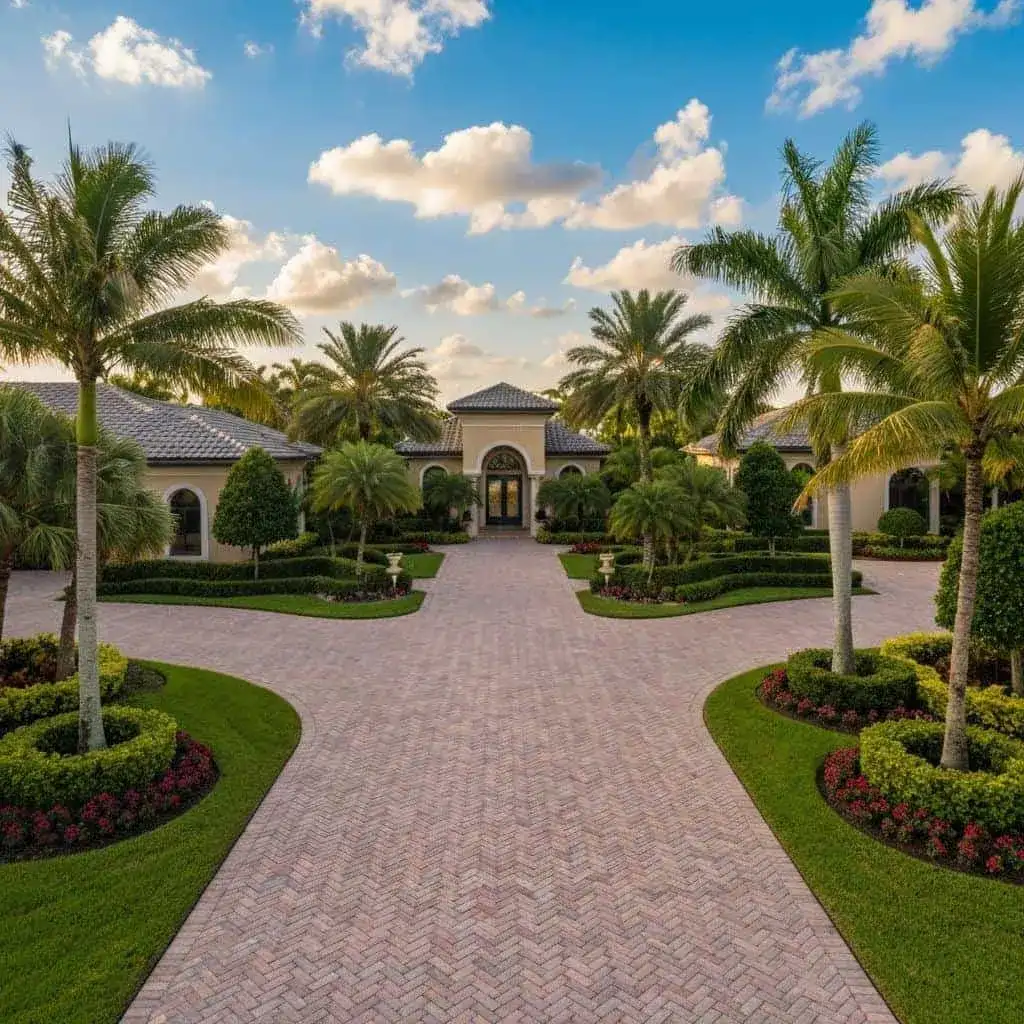
Professional Paver Installation That Outlasts Florida's Climate
Engineered sub-grade systems, drainage management, HOA ARC handling, and premium materials — built for South Florida's sandy terrain, tropical rainfall, salt air, and extreme UV conditions.
Florida-Specific Sub-Grade Engineering
Geotextile fabric, 6–12" compacted limestone base, 95% Proctor compaction — calibrated to sandy soil, clay, or muck conditions by address
Drainage Management Built In
Minimum 1–2% slope grade, integrated French drains and channel drains engineered before the first paver is laid
Marine-Grade Joint Compound for Coastal Properties
Standard polymeric sand for inland. Marine-grade for Intracoastal and beachfront. The joint that fails is the one the contractor didn't specify correctly
HOA ARC Application Packages
Scaled drawings, material specs, contractor credentials — complete package prepared and submitted for every governed-community project
Why Interlocking Pavers Outperform Concrete & Asphalt in Florida
Florida's sandy soil, tropical rainfall, and hurricane exposure expose every weakness in monolithic surfaces. Interlocking pavers address each one by design.
| Factor | Interlocking Pavers | Poured Concrete | Asphalt |
|---|---|---|---|
| Florida Sandy Soil | Flexes with soil movement — no cracking | Cracks within 5–10 years under soil shift | Softens and ruts in summer heat |
| Repair Method | Individual units lifted and replaced — no demolition | Jackhammer, haul, repour, cure: 7–10 days | Section saw-cut, repour, re-roll |
| Drainage Options | Permeable systems available for flood zones | Impervious — add channels only at curbs | Impervious — no permeable option |
| Hurricane Surge Recovery | Individual units reset — no replacement cost | Full slab replacement if cracked by surge | Full section replacement |
| Lifespan (maintained) | 30–50+ years | 10–20 years in Florida climate | 10–15 years |
| HOA Approval | Generally preferred or required by HOA guidelines | Accepted in most jurisdictions | Often restricted in residential HOAs |
| Property Value Impact | 10–15% outdoor living value increase documented | Minimal uplift beyond curb appeal | Neutral or negative in premium neighborhoods |
| Cost (installed) | $12–$32/sq ft depending on material | $8–$15/sq ft | $5–$10/sq ft |
What South Florida Does to Pavers — And How We Engineer Around It
Generic paver specifications designed for Georgia or the Carolinas fail in South Florida within 5 years. Every condition below requires a Florida-specific engineering response.
| Condition | South Florida Reality | Our Engineering Response |
|---|---|---|
| Sandy Soil Subgrade | Expansive sandy fill throughout Palm Beach & Broward | Geotextile separation fabric + compacted limestone base in 2-inch lifts at 95% Proctor |
| Muck & Organic Soil | Near canals, lakes, and coastal lowlands (Lake Osborne, C-51 canal area) | Muck excavated and replaced with structural fill before base installation |
| Tropical Rainfall | 57–65 inches/year · Peak June–September | Minimum 1–2% drainage slope + French drains or channel drains integrated in base design |
| Salt Air Exposure | Intracoastal and beachfront properties — continuous salt loading | Marine-grade polymeric joint compound; 18–24-month sealing cycle for beachfront |
| UV Index 11–12 (Extreme) | April–September sustained extreme UV — fades colors, degrades sealers | UV-resistant penetrating sealers; material selection calibrated to UV exposure |
| FEMA Flood Zones | Zone VE (beachfront), Zone AE (Intracoastal, canals, lakefront), Zone X | Permeable paver systems for AE/VE; open-grade bases for post-surge reset capability |
| Hurricane Wind & Surge | Category 1–5 hurricane corridor; storm surge potential throughout coastal PBC | Interlocking system designed for individual unit reset, not total replacement, after surge |
| HOA Compliance | Hundreds of Palm Beach County HOAs require ARC approval before permits | Full ARC application package prepared and submitted; permit filed only after written approval |
The base system is the installation — Pavers are a finished surface. The base system is the structural element. A $6/sq ft concrete paver on a properly engineered base will outlast a $28/sq ft travertine tile on an under-specified base. Every Craft Pavers estimate includes the full base specification — excavation depth, aggregate type, compaction standard, geotextile, drainage design, and edge restraint — not just material and labor line items.
One permit contact, one joint compound spec, one sealing schedule — varies by address — Every Juno Beach beachfront installation has different requirements than an inland Greenacres driveway. We identify the relevant municipality, flood zone, soil condition, HOA requirement, and coastal exposure at the site visit. Those findings determine the spec — not a one-size-fits-all proposal sent without visiting the property.
Every Paver Installation Type We Build
Each project type has different load requirements, drainage priorities, and material considerations. Here's how we approach each one in South Florida's conditions.
Driveway Paver Installation
Heavy Load · Vehicle Traffic · Drainage Critical
- Base depth: 8–12 inches of compacted aggregate (not 4–6 inches) for vehicle load distribution
- Geotextile separation fabric on all sandy-soil subgrades prevents base migration
- Minimum 1–2% slope away from garage and structures to control sheet runoff
- ASTM C936 concrete pavers at 8,000+ PSI compressive strength for heavy vehicles, RVs, and boat trailers
- Boat trailer clearance driveways: wider-format patterns with reinforced edge restraint at turning radii
- Permeable concrete paver option for FEMA flood zone addresses or municipalities with impervious surface limits
Pool Deck Paver Installation
Cool Touch · Non-Slip · Salt & Chlorine Resistant
- Travertine standard: surface stays 20–30°F cooler than poured concrete in direct South Florida sun
- Brushed or tumbled finish: DCOF 0.65+ — exceeds ADA slip-resistance requirements when wet
- Drainage graded away from pool equipment pad and home foundation — critical in tropical rainfall
- Salt-chlorine-resistant sealer applied at 4–6 week post-installation mark after efflorescence dissipates
- Coastal properties: 18–24-month sealing cycle. Inland: 3-year cycle. Written schedule included.
- ARC application includes pool deck dimensions and material specs for governed community HOAs
Patio & Outdoor Living Installation
Year-Round Living · Custom Patterns · Kitchen Ready
- South Florida's year-round outdoor lifestyle makes patios the highest-ROI project type in the region
- Custom patterns: herringbone, running bond, basketweave, European fan, or custom hybrid designs
- Outdoor kitchen pavers: reinforced base under appliance footprint areas, gas and electrical access planned pre-installation
- Pergola and shade structure integration: concrete poured footing locations coordinated with paver layout before any cutting begins
- Seamless indoor-outdoor visual flow: matching material or complementary tones to interior flooring
- Intracoastal-front patios: marine-grade jointing compound standard, 2-year sealing cycle
Walkway & Entry Paver Installation
Curb Appeal · ADA Compliant · HOA Approved
- Front entry walkways: the highest-visibility paver project — material selection and pattern reflect the home's architectural character
- ADA compliance: minimum 36-inch clear width, cross-slope ≤2%, running slope ≤5% for accessible routes
- Lighting integration: step lighting and pathway lights specified at design stage — sea turtle compliant amber LEDs for coastal properties
- Side yard and utility walkways: concrete pavers with wide-joint permeable option for drainage management alongside foundations
- HOA ARC applications: walkway scope includes dimensions, material, pattern, and edge treatment — all required documentation prepared
- Paver-to-concrete transitions: proper expansion joints and edge restraint where pavers meet existing concrete slabs or curbs
Travertine Paver Installation
Cool-Touch · Natural Stone · Pool Deck Standard
- Natural porous microstructure dissipates heat — surface stays 20–25°F cooler than concrete in direct South Florida midday sun
- Brushed and tumbled finishes rated DCOF 0.60+ for wet-surface traction — meets Florida pool deck slip resistance requirements
- Versailles pattern in tumbled travertine: accepted by the overwhelming majority of Palm Beach and Broward HOAs
- Colors: Ivory, Walnut, Silver, and Noce — confirmed on-site with physical samples in your home's light conditions
- Sealing cycle: 18 months for coastal/shaded; 2.5–3 years for inland/full-sun — written schedule with every installation
- Compatible with pool chemistry when sealed — no degradation from chlorine or salt-chlorine systems
Porcelain Paver Installation
Zero Maintenance · Mold-Proof · Large Format
- Kiln-fired at 2,200°F — zero-porosity surface: no sealing required, no mold foothold, no tannin or pool chemical penetration
- UV-stable kiln-fired pigmentation: does not fade under Florida's UV index 11–12 — color holds for the lifespan of the installation
- Available in large-format slabs up to 48"×48" for seamless contemporary outdoor living spaces
- Textured and structured finishes rated DCOF 0.60+ for pool decks and rain-exposed patios
- Stone-look, wood-look, and concrete-look surface options — can match or complement interior flooring collections
- No mandatory sealing schedule — lowest lifetime maintenance cost of any paver material available
The Craft Pavers Installation Process
Six engineered steps — each designed to address the specific challenges of Florida's climate, soil, HOA requirements, and drainage conditions. No shortcuts, no steps skipped.
Free On-Site Assessment & Soil Evaluation
We visit your property, assess soil composition (sandy fill vs. clay vs. muck), measure drainage slopes, identify FEMA flood zone designation, confirm HOA status, and document all existing conditions. No quotes from photos — every estimate is built on what we see on-site.
HOA ARC Submission & Permit Acquisition
For governed communities, we prepare and submit the full ARC package (scope, scaled drawing, material specs, contractor license, COI) and wait for written approval before filing the permit. For permitted projects, we handle the municipal permit application and NOC recording with the county Clerk of Courts.
Sub-Grade Excavation & Soil Stabilization
We excavate to required depth (8–12 inches for driveways, 6–8 inches for patios), remove all organic material, and compact the sub-grade to 95% Proctor density using plate compactors. For muck soils (near Lake Osborne, canals, or coastal areas), organic material is removed and replaced with structural fill before base installation begins.
Base Course, Drainage Engineering & Edge Restraint
FDOT-approved compacted limestone aggregate base installed in 2-inch compaction lifts with minimum 1–2% slope away from all structures. Geotextile weed and separation fabric installed on prepared subgrade before base stone. French drains, channel drains, or dry wells integrated where drainage challenges are identified. Perimeter edge restraints spiked at 12-inch intervals.
Bedding Sand & Paver Laying
A 1-inch layer of coarse bedding sand is screeded to a precise level. Pavers are hand-laid in your chosen pattern — herringbone, running bond, basketweave, or custom — with consistent joint spacing. Cuts made with a masonry saw (not a cold chisel) for clean, precise edges at all borders and obstacles.
Joint Stabilization, Final Compaction & Sealing Schedule
Marine-grade or standard polymeric joint compound swept into all joints (based on coastal exposure) and activated with water, creating a weed-resistant, insect-blocking bond. Final plate compaction locks the system together. A written sealing schedule — calibrated to the property's salt exposure and material — is provided with every project. First seal at 4–6 weeks post-installation after efflorescence dissipation.
Paver Materials for Florida's Climate
Material selection in South Florida is not aesthetic preference — it is engineering. The right material depends on location (coastal vs. inland), use (pool deck vs. driveway), and flood zone designation.
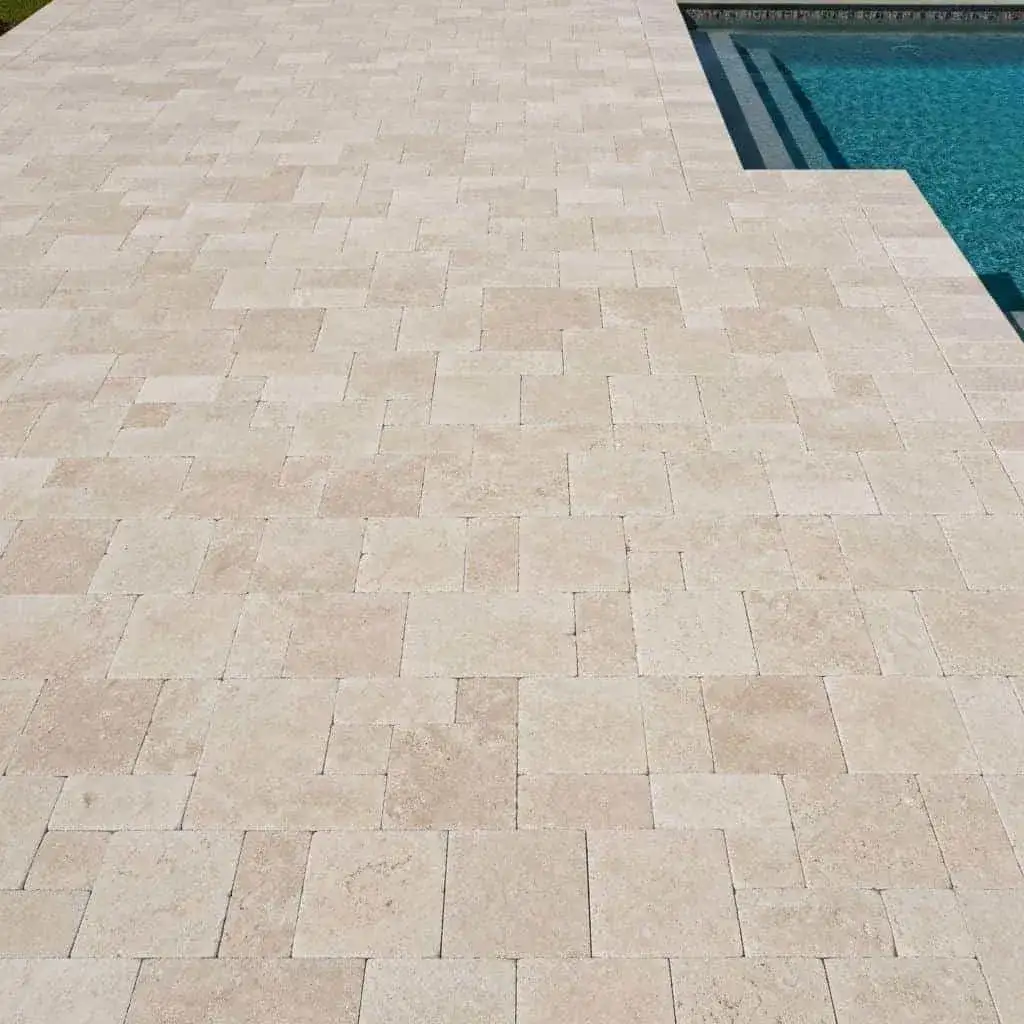 Best for Pool Decks
 Travertine Pavers
The South Florida Pool Deck Standard
Travertine's natural porous microstructure dissipates heat rather than storing it — a physical property that makes it the correct choice for South Florida pool decks, not merely a stylistic one.
- Surface stays up to 30°F cooler than poured concrete in direct midday sun
- Brushed and tumbled finishes maintain a DCOF of 0.65+, exceeding ADA slip-resistance requirements
- Naturally compatible with pool chemistry — does not degrade from chlorine splash or salt air when properly sealed
- Coastal properties: 18–24-month sealing cycle. Inland: 3-year cycle.
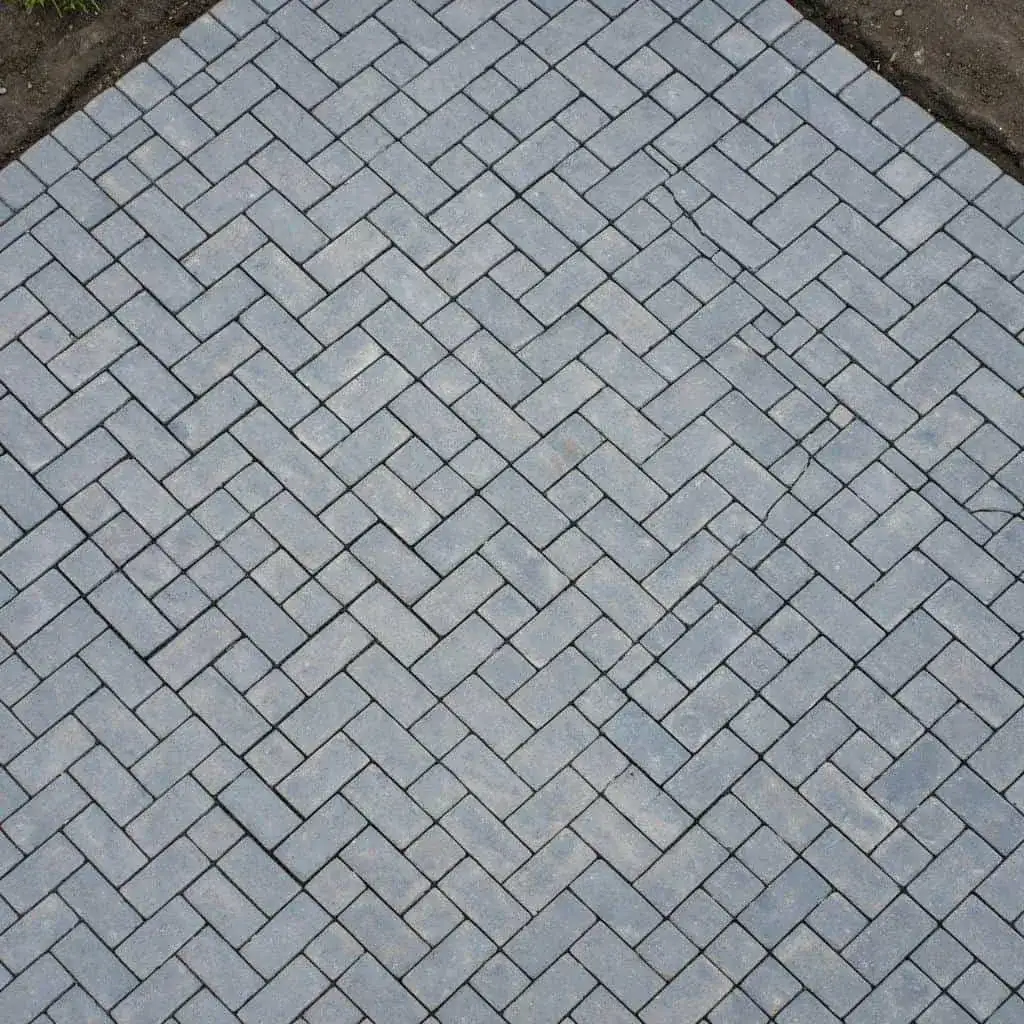 Best for Driveways
 Interlocking Concrete Pavers
The Florida Driveway Workhorse
Manufactured to ASTM C936 standards, interlocking concrete pavers are the most versatile and cost-effective solution for large-scale residential driveways and commercial installations.
- Interlocking system distributes load across the base — individual units flex instead of cracking under Florida's sandy soil movement
- 8,000+ PSI compressive strength handles daily heavy vehicle traffic, RVs, and boat trailers
- Individual units lift cleanly for utility access — no jackhammer demolition or concrete disposal
- Upgrade to permeable concrete pavers available for FEMA flood zone addresses
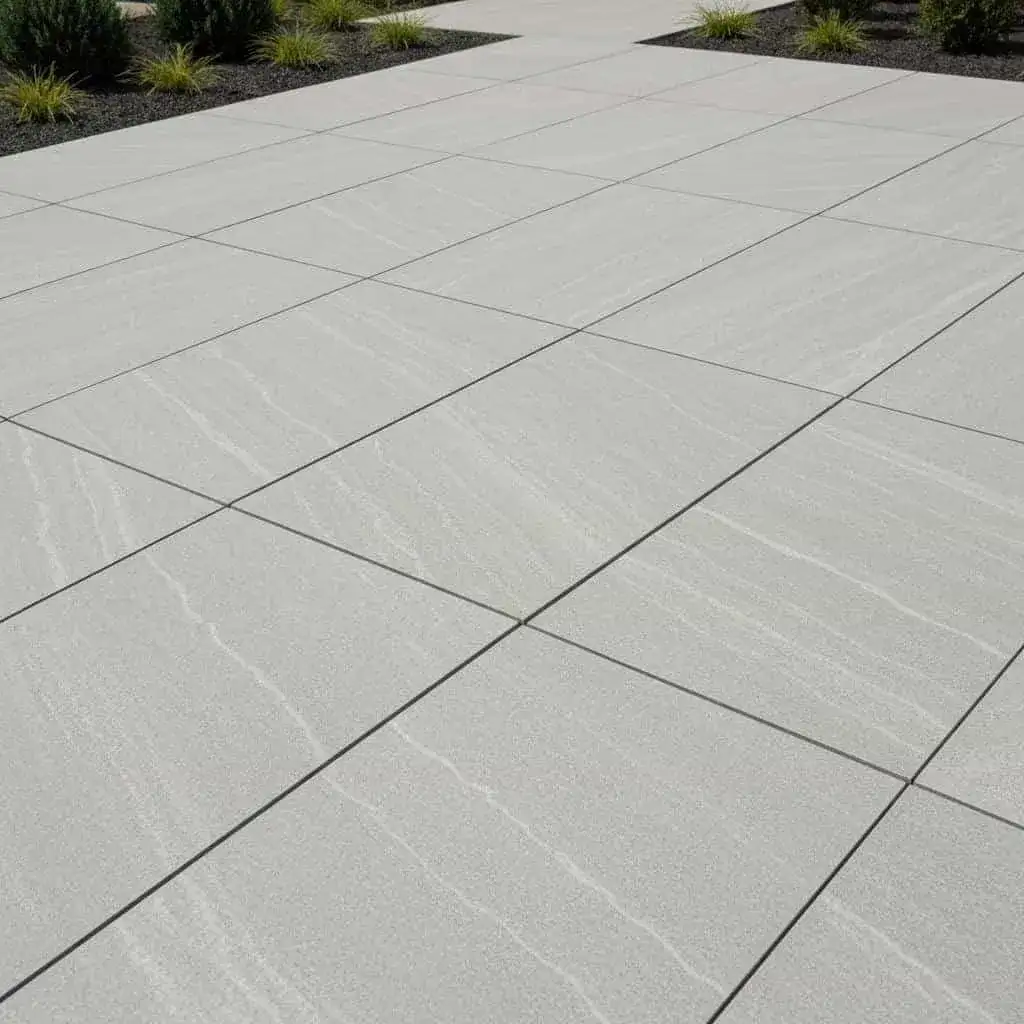 Best for Modern Patios
 Porcelain Pavers
Zero-Porosity. Zero Compromise.
Fired at 2,200°F, porcelain pavers achieve a zero-porosity surface that is inherently resistant to mold, mildew, staining, and UV fading — the lowest long-term maintenance option available.
- Non-porous surface offers zero foothold for Florida's mold and algae spores — no sealer required for protection
- Kiln-fired pigmentation does not fade under Florida's UV index 11–12 (Extreme)
- Pool chemicals, tannins, rust, and food stains wipe clean without penetrating the surface
- Available in slabs up to 48"×48" for seamless contemporary outdoor living spaces
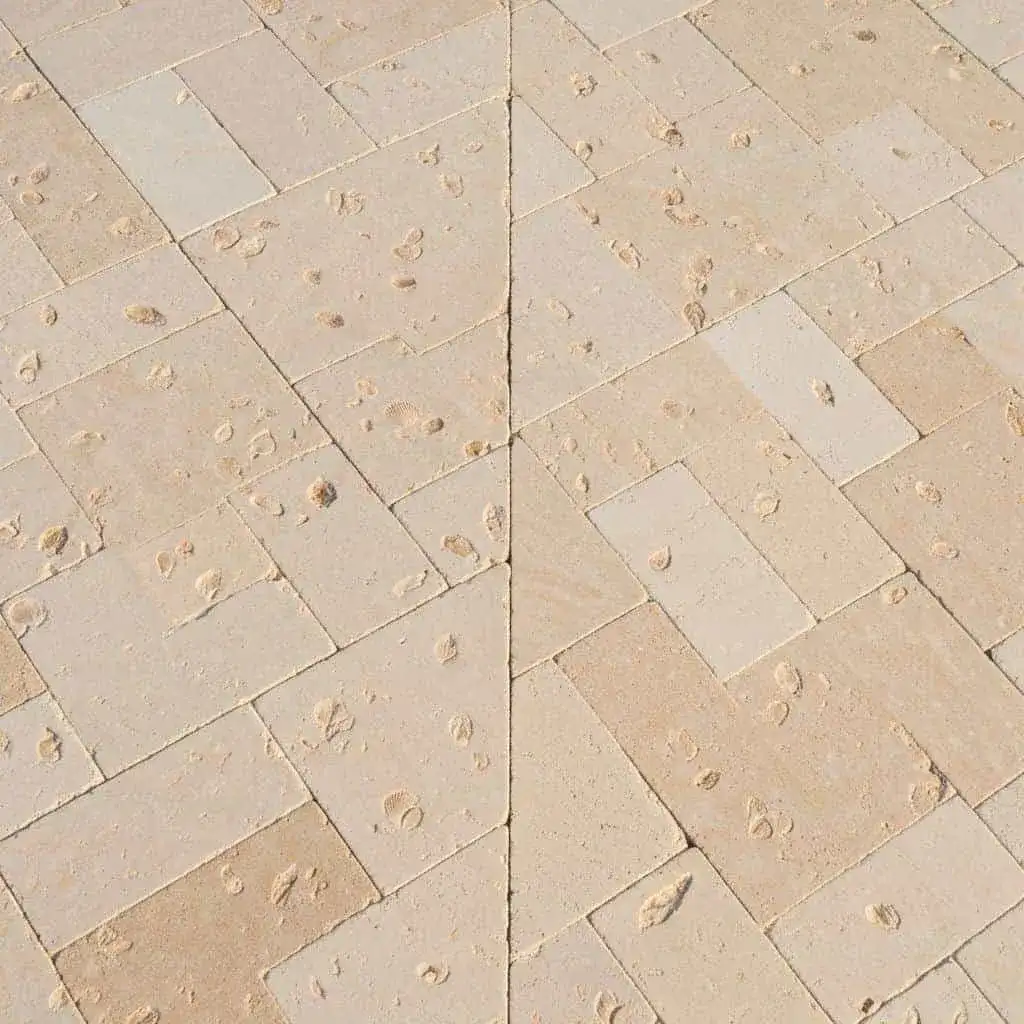 Best for Luxury Estates
 Marble & Shellstone (Coquina)
Coastal Luxury Redefined
Shellstone — Florida's native coquina limestone — and imported marble deliver an incomparable natural aesthetic unique to coastal South Florida's most prestigious properties.
- No two slabs are identical — natural veining and shell fossil inclusions create a living, unrepeatable surface
- Geologically stable in marine environments — coquina is native to South Florida's coastal geology
- Luxury natural stone installations consistently yield 10–15% outdoor living value increases in Palm Beach County
- Significantly better thermal comfort than dark concrete or porcelain under direct sun
What Does Paver Installation Cost in South Florida?
Installed price includes material, base preparation, labor, polymeric joint compound, edge restraint, and cleanup. Permit fees, NOC recording, HOA application prep, and specialty drainage itemized separately on every estimate.
| Material | Installed / sq ft | Best For | Sealing Cycle |
|---|---|---|---|
| Concrete Pavers | $12 – $21 | Driveways, inland patios, HOA-governed communities | 2.5–4 years (by exposure) |
| Permeable Concrete Pavers | $14 – $23 | FEMA Zone AE/VE, flood-zone driveways, stormwater compliance | 3–4 years |
| Travertine | $17 – $28 | Pool decks, Intracoastal patios, luxury outdoor living | 18 mo–3 years (by zone) |
| Natural Limestone / Shellstone | $19 – $30 | Coastal-native estates, premium pool surrounds, oceanfront patios | 18 mo–3 years (by zone) |
| Porcelain | $20 – $32 | Contemporary outdoor kitchens, high-end pool decks, modern patios | 2–3 years |
| Marble | $22 – $35+ | Ultra-luxury estate entry and entertaining areas | 2 years |
Coastal upcharge: Beachfront and direct Intracoastal properties add marine-grade polymeric joint compound — approximately $0.30–$0.50/sq ft.
Soil upcharge: Muck soil remediation (canal-adjacent, Lake Osborne area) adds $1,500–$4,000. Deep clay base (inland Palm Beach County) adds $1–$2/sq ft.
Project minimums: Craft Pavers typically does not quote projects under 300 sq ft. Free estimates are on-site — no quotes from photos or measurements provided by homeowners.
Palm Beach County Has Hundreds of HOAs — We Handle Every One
The single most common reason paver projects stall in Palm Beach and Broward Counties is HOA paperwork submitted out of order. The permit cannot be filed before ARC approval. We know the sequence, prepare the package, and manage the process.
ARC Application Preparation
Complete package: written scope with dimensions, scaled site drawing, material specification sheet, contractor license number, and current Certificate of Insurance. Every document the HOA requires, in the format they expect.
Correct Sequencing
HOA ARC approval must come before the municipal permit application — not simultaneously. We schedule the process: ARC first (7–30 days), then permit (7–14 business days), then installation. No mid-project surprises.
Notice of Commencement (NOC)
For projects at $2,500+, the NOC must be notarized and recorded with the county Clerk of Courts before work begins — and posted at the site before the first inspection request. We handle notarization and recording.
Jurisdiction Identification
City limits, unincorporated county, and municipal utility authority boundaries determine which permit office governs each project. Some addresses (like Hypoluxo Island) require extra verification by parcel data, not zip code.
Permit Fee Transparency
Permit fees vary by municipality, project valuation, and scope. We include estimated permit fees in the written estimate — not as a surprise line item when the permit is issued.
Inspection Coordination
Most Florida municipalities require one or more building inspections during and after paver installation. We schedule required inspections, ensure the project passes on the first visit, and provide documentation for HOA files.
Paver Installation Across South Florida
Each city has different soil conditions, flood zone designations, permit offices, and HOA landscapes. Click any city for the local-specific installation guide.
Don't see your city? Request an estimate — we serve all of Palm Beach and Broward Counties and Lee County.
Paver Installation Questions Answered
Ready to Transform Your Outdoor Space?
Free on-site estimate. All permits and HOA packages handled. Itemized written quote within 24 hours. No quote-from-photos. No hidden line items.