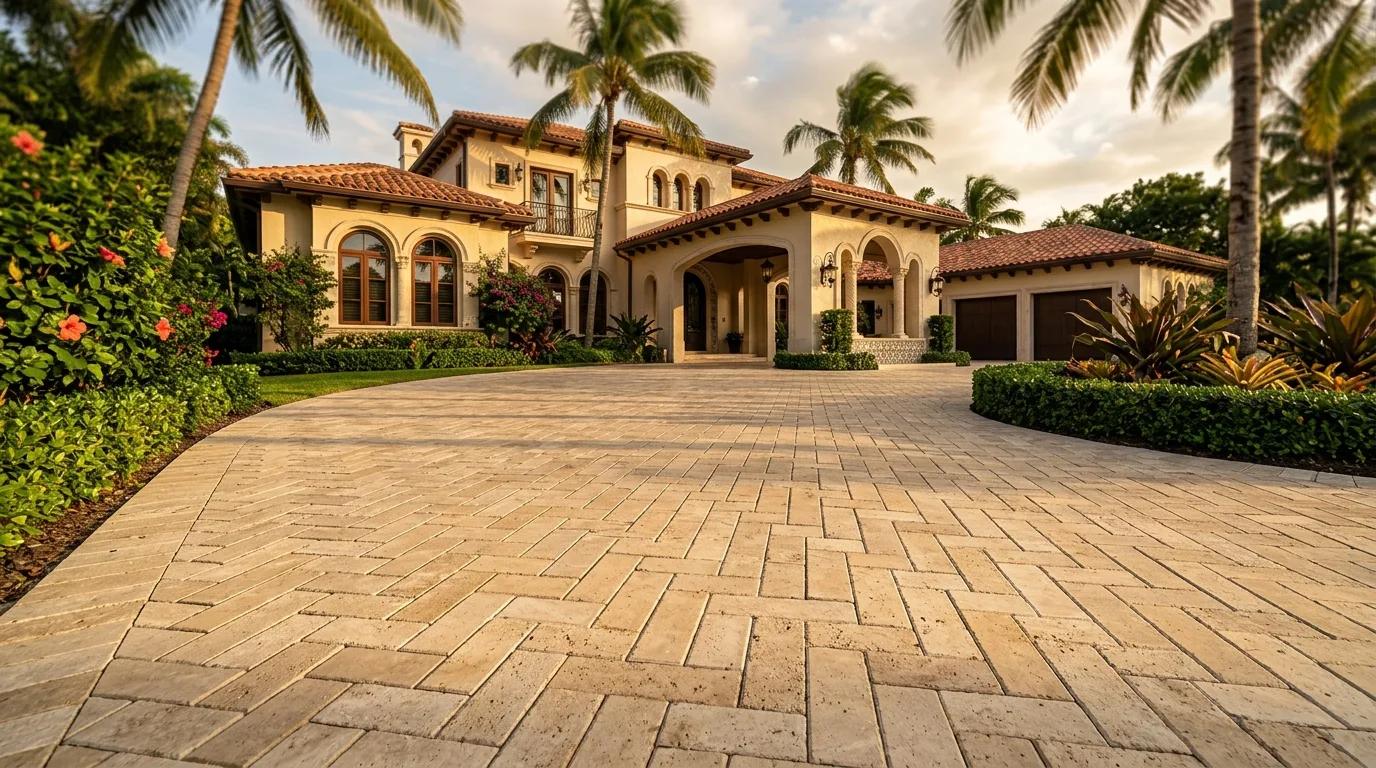
Good paver design ideas usually come from two places at once: what you actually like, and what South Florida’s sun, salt, and HOA rules will let you keep for the next fifteen years. Most of the design help online skips the second half. This is the field version — patterns, palettes, and mistakes — from a licensed contractor (CILB #U-22487) who has installed pavers on every kind of Palm Beach and Broward property, from single-story ranches in Boca to estate driveways in Delray.
The 20/80 of Paver Design
Homeowners tend to obsess over pattern choice and underestimate everything else. In our experience, roughly 20% of a paver project’s final look comes from the pattern itself. The other 80% comes from four things:
- Color and tonal contrast with your house and landscaping.
- Border design — how the edge is framed and where the field ends.
- Scale — the size of the paver unit relative to the space.
- Transitions — how one paved area meets the next (driveway to walkway, patio to pool deck).
Get those four right with a plain running bond, and the result will look better than a perfectly-laid Versailles pattern in the wrong color. Get them wrong with a fancy pattern, and no amount of pattern can save the project. This is what “curb appeal” actually means when you break it down.
The local constraint layer sits on top: sun exposure (barefoot temperature on pool decks matters here), HOA color palettes (real in most West Boca and Broward communities), and the reality that Florida rain will find any low spot in your grading within the first storm. Design ideas that ignore those don’t survive contact with the property.
The Core Paver Patterns and When to Use Each
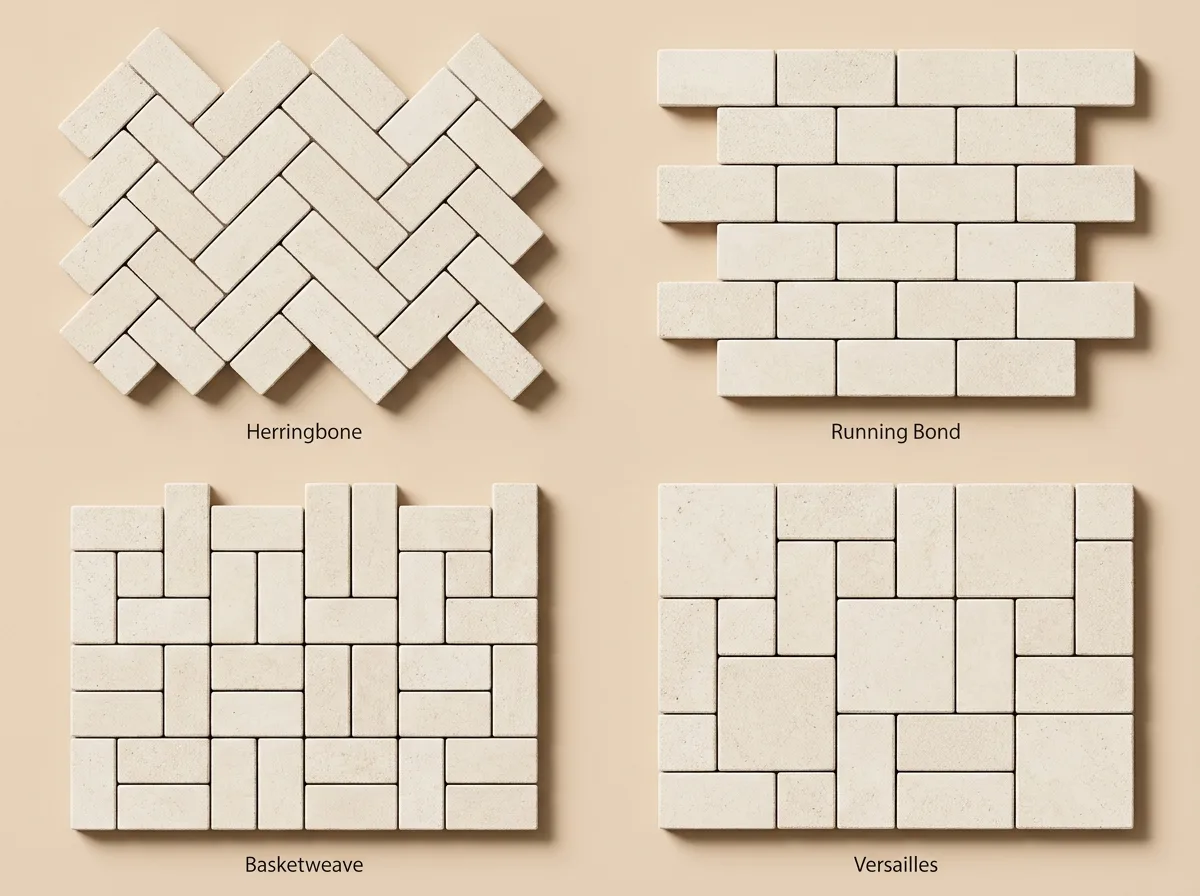
Six patterns cover roughly 95% of what we install. Each has a job it does well and a job it doesn’t.
Herringbone (45° or 90°). The workhorse. Rectangular pavers laid in interlocking L-shapes. The 45-degree version is the strongest driveway pattern because the interlock resists tire-turn stress from every direction. The 90-degree version reads more geometric and works well on patios. If you’re paralyzed by the choice, herringbone at 45 is almost never wrong.
Running Bond. Rectangular pavers offset by half a length, like brick. Modern, clean, cheapest on cuts (less waste), and fastest to install — which usually means the best labor price. Great for walkways, contemporary patios, and any yard where you want the pavers to feel calm rather than assertive. Weakest under sustained vehicle traffic; we don’t recommend it for daily-drive driveways.
Basketweave. Pairs of pavers laid at right angles to alternating pairs. Reads traditional, almost English-garden. Beautiful on courtyards and formal front entries; feels out of place on modern architecture. Requires perfectly-square pavers to look right — cheap concrete units with rough edges will fight you.
Versailles (French Pattern). Four different paver sizes laid in a repeating puzzle-like arrangement. This is the estate look — Old-World, unmistakably premium, and heavily associated with travertine. It’s what we install on Palm Beach oceanfront properties and on tuscan-styled homes in west Boca. Expensive per square foot because of the size mix and the layout labor, but nothing else photographs the same way.
Random Ashlar. Similar spirit to Versailles but with more variation and no strict repeat. Reads natural-stone-quarry, works beautifully with travertine and porcelain that mimics stone. Good middle ground when Versailles feels too formal.
Circular / Radial. Pavers laid in expanding rings, usually around a focal point (a fountain, a fire pit, a driveway turnaround). Costs more (curves = cuts = waste) and needs a large enough space to breathe — under 400 square feet, circular starts to look like a bullseye instead of a design.
For driveways specifically, we walk through the structural reasoning in more depth in our paver installation guide, because the pattern choice interacts with base prep and edge restraint in ways most quotes gloss over.
Paver Color Palettes for South Florida Homes
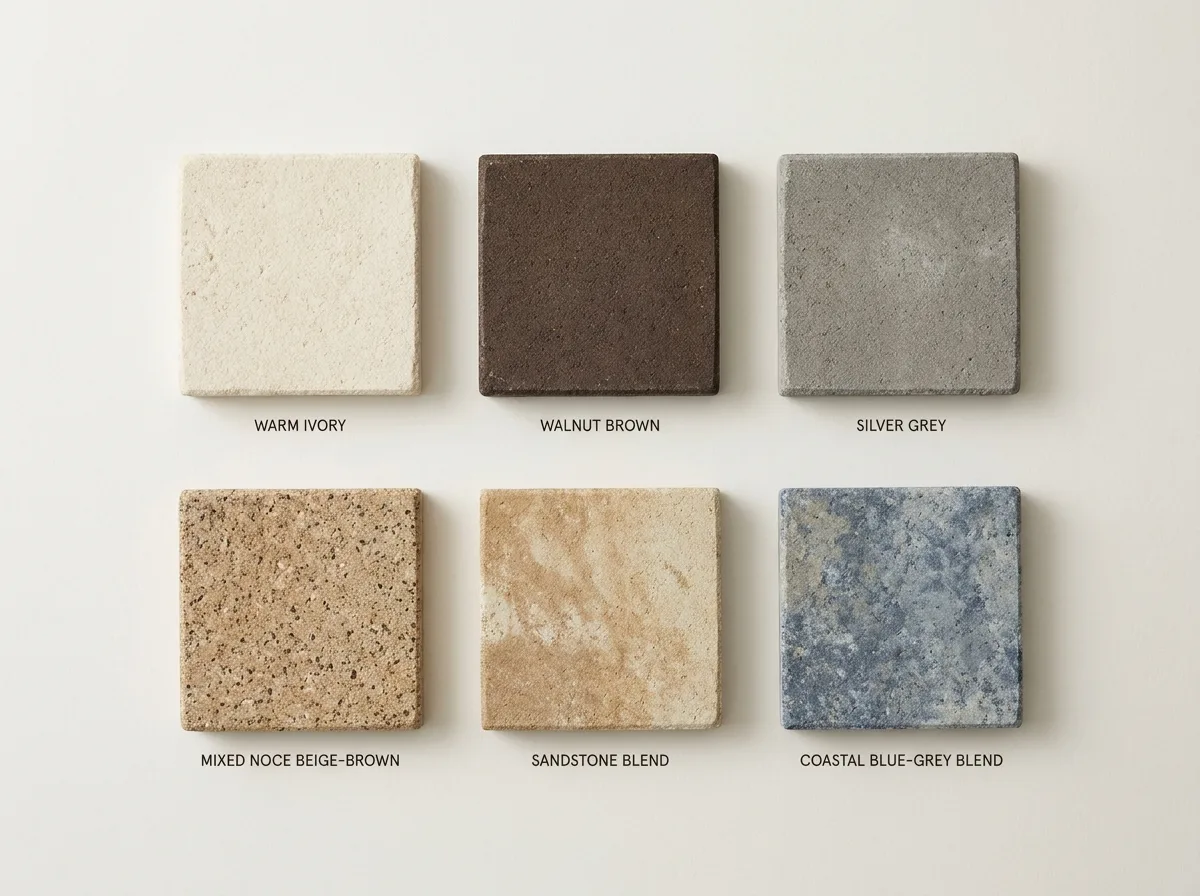
Florida is a color-punishing climate — UV Index 11+, salt haze from the coast, pollen every spring, and rain marks after every storm. The palettes that survive here fall into three families:
Mediterranean / Tuscan. Warm ivories, terra-cotta accents, tumbled travertine in ivory or walnut. Pairs with barrel-tile roofs and stucco in cream, blush, or ochre. This is the dominant look in older Boca Raton, Delray, and most of Palm Beach — for good reason, since it evolved specifically to reflect the sun. Travertine at $17–$28/sq ft installed is the natural material choice here; we cover the specifics in our travertine pavers cost guide.
Coastal Modern. Cool off-whites, soft greys, sand tones. Larger-format porcelain pavers in matte finish. Pairs with white stucco, dark aluminum trim, glass railings — the architecture you see in newer coastal builds from Fort Lauderdale up through Highland Beach. Porcelain at $20–$32/sq ft installed hits this look precisely and stays cool underfoot on pool decks; the travertine vs porcelain comparison covers the durability trade-offs honestly.
Traditional / Transitional. Blended concrete pavers in beige-and-charcoal ranges. Pairs with any conventional Florida house — one-story block, two-story stucco, or the mixed-material contemporary homes that have taken over new construction. Concrete pavers at $12–$16/sq ft installed hit this look at the lowest price point.
Two rules that hold across all three: avoid solid black or very dark greys unless the surface is fully shaded (surface temps hit 140°F+ in July and burn bare feet), and avoid pure bright white on driveways (every oil drip and tire mark shows within a month). The winners are warm and mid-toned.
Application-Specific Design Ideas
Different surfaces want different design logic. What looks great on a patio can be structurally wrong for a driveway, and vice versa.
Driveway. 45-degree herringbone in a mid-tone blended color. Soldier-course border in a contrasting tone or the same field paver rotated 90 degrees. If the driveway is longer than 40 feet, break it up with a subtle band across the middle — a single soldier-course line — to give the eye a resting point. Avoid busy multi-color blends here; from the street, they read as visually noisy.
Patio. Running bond or 90-degree herringbone. Larger paver units (16×24 or 24×24) make even a modest patio feel more expensive. Border only if there’s a real transition — grass, gravel, another material — otherwise let the field run to a clean edge.
Pool Deck. This is where material choice matters more than pattern. Travertine or shell-textured porcelain in an ivory or light beige, laid in French pattern or random ashlar. The priority is barefoot temperature and slip resistance, not pattern complexity. Our pool deck paver service covers the coping-to-deck transition detail that most jobs get wrong.
Walkway. Running bond or a tight herringbone. Keep it narrow-scaled — a walkway laid in Versailles pattern looks like the paver ran out of somewhere else to go. If the walkway curves, use rectangular pavers laid perpendicular to the direction of travel, not parallel — it reads more intentional and hides the cuts.
Outdoor Kitchen / Grill Zone. Match the patio field, but add a subtle framing element — a soldier course around the perimeter of the kitchen “room” to define it as its own space without a physical wall. This is the trick that makes outdoor kitchens feel architected rather than dropped in.
Border and Accent Design Tricks
A well-designed border is what separates a project that looks contracted from one that looks landscaped. Three moves that consistently work:
The Soldier Course. A single row of pavers laid perpendicular to the field, framing the perimeter. Costs relatively little and adds a huge amount of finished-look. Use it on driveways, patios, and formal walkways. Skip it on small utility walkways where it visually shrinks the width.
Contrast Border. Same paver, different color — usually a darker or lighter tone in the same family. Effective on driveways when the contrast is subtle (one shade darker), disastrous when the contrast is loud (black border on beige field reads like a coloring book).
Transitions. Where two paved areas meet, insert either a full soldier course, a material change (paver to travertine coping), or a planter/garden bed. Never let two different paver patterns simply butt into each other — the eye will spot the mismatch every time.
The scale of the border should match the scale of the field. A 250-square-foot patio with a triple-course border looks over-framed; a 3,000-square-foot driveway with a single 4-inch border looks under-framed. Rule of thumb: border width around 3–6% of the field’s shortest dimension.
HOA Design Constraints in Palm Beach and Broward
Most master-planned communities in West Boca (Boca West, Broken Sound, St. Andrews) and much of Coral Springs, Weston, and Parkland have architectural committees that must approve paver work before installation. This is not optional — installing without approval can trigger a demand to remove and reinstall at your cost.
Common constraints we work around:
- Color palettes limited to community-approved swatches, usually earth tones. Solid grey and black are the most-often-rejected choices.
- Pattern restrictions on driveways — some HOAs require herringbone or running bond only.
- Border width limits and rules against contrast borders that read too loud from the street.
- Percentage-of-lot hard caps on total impervious surface — this affects patios and pool decks especially.
Bring your community’s design guidelines to the first estimate. A good contractor should redesign around those constraints before you submit anything to the committee, not after.
Modern vs Traditional Aesthetic
The single biggest design decision is which of these two worlds your project belongs in. They call for opposite moves.
Modern. Large-format pavers (16×24, 24×24, or larger), running bond or offset patterns, monochromatic palette, minimal border, sharp lines. Pairs with contemporary architecture, dark trim, glass railings, minimal landscaping. Porcelain excels here.
Traditional. Smaller-format pavers (4×8, 6×9), herringbone or basketweave, warm blended palette, soldier-course borders, curves welcome. Pairs with barrel-tile roofs, stucco arches, lush plantings. Concrete pavers and travertine both work.
The trap is mixing them. A modern large-format grey paver with a soldier-course border around a curved patio reads confused, not eclectic. Pick a lane and commit — the small details that look “wrong” together are usually the ones telegraphing that a project changed direction mid-design.
Common Design Mistakes We Get Called to Fix
We do enough repair and reinstall work to have a short list of mistakes that come up over and over. Avoid these four and you’re ahead of most of the market:
1. Fake stone that fools no one. Very cheap concrete pavers molded to look like natural stone tend to have repeating textures that become obvious over a large surface. If budget is the constraint, plain concrete in a solid color reads more honest — and better — than a bad imitation.
2. Over-mixing patterns. Herringbone in the driveway, Versailles on the patio, running bond on the walkway. Each pattern is fine, but three of them fighting on one property looks unresolved. One primary pattern for the whole property, with at most one accent pattern in a specific feature zone (a firepit, an entry medallion).
3. Wrong border scale. Border either dominating a small field or vanishing on a large one. See the 3–6% rule above.
4. Skipping the transition detail. The most common single failure. Driveway ends, walkway begins, no plan for the join — pavers just butt together at whatever angle geometry produced. The fix is a soldier course, a material change, or a garden bed. Any of the three costs little and finishes the design.
Two mistakes we see less often but that are more expensive to undo: laying pavers over an inadequate base (Florida’s sand base needs proper depth and compaction, or the surface waves within two years), and choosing a dark color for a barefoot-traffic surface. Both require full teardown to fix; the first can even affect your ability to seal the surface later if joints have washed out.
Paver Patio Ideas Beyond the Field Itself: Full Outdoor Living Design
Paver design ideas rarely stop at the patio surface — the properties that read as premium are the ones where the paver patio, walkways, driveway, and outdoor living space are designed as one hardscape system. A few of the elements that turn a paver installation into a full outdoor living area:
- A well-designed paver patio paired with an outdoor kitchen, fire pit, or pergola creates the “outdoor room” buyers pay for. The patio design is the anchor; the pergola gives it vertical presence; the outdoor fire gives it a reason to be used at night.
- Retaining wall or wall block detailing in a matching or complementary paver material ties the patio into sloped yards and turns dead grade changes into intentional landscape design.
- Mixed materials — travertine field with flagstone or bluestone accents, brick pavers used as a soldier-course border on a concrete paver body, natural stone pavers as stepping-stones through pea gravel — all add visual interest and a natural look that a single-material field cannot.
- Paver walkway ideas should mirror the patio’s palette and pattern language, not compete with it. A running-bond walkway feeds cleanly into a herringbone patio because the joint direction changes at the transition, not the tone.
The paver patio design decisions that make the biggest visible difference are the ones about how the hardscape connects to the greenery, the pool deck, and the existing home — not the pattern of any single square. That’s the difference between “patio ideas” and hardscape design: the second one plans the whole outdoor area, and the first only plans the tiles.
Getting a Design That Fits Your Property
Design ideas on paper are the easy part. The harder part is walking a property and seeing which ideas will actually land in that specific space — with its sun angles, sightlines, drainage, existing architecture, and, in this market, HOA rules.
We do free on-site design consultations across Palm Beach and Broward County — including a walk-through of the property, honest recommendations on pattern and palette (including the pattern we’d talk you out of), a look at material samples in the actual light your project will live in, and a written estimate. Our installs run $12–$16/sq ft for concrete pavers, $17–$28/sq ft for travertine, and $20–$32/sq ft for porcelain, all-in. Same crew, same warranty, whether the project is a 300-square-foot patio or a full drive-plus-deck redesign.
If you’re at the ideas stage, that’s the right time to call. The best design decisions are made before the first paver is cut, not after.