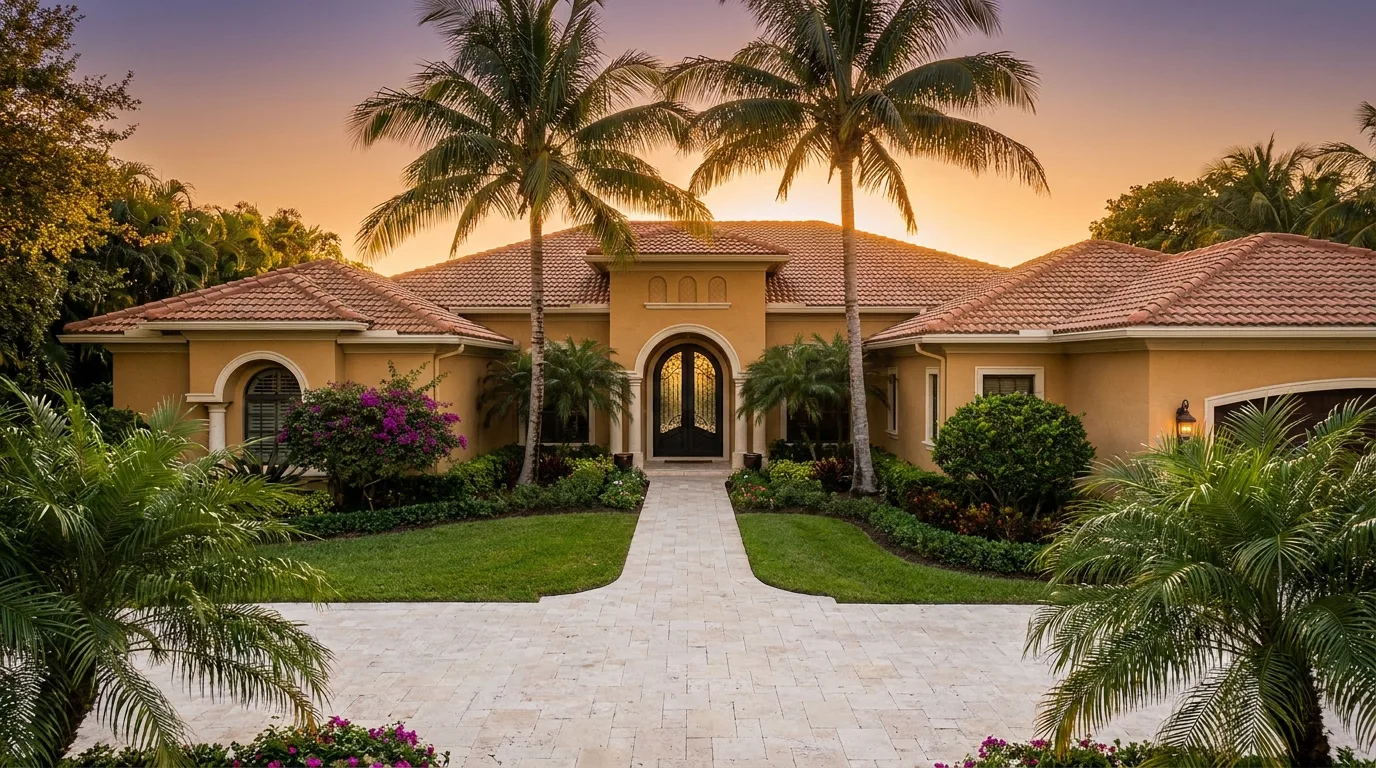
Color is the decision homeowners obsess over and, honestly, the one they most often get wrong. It’s not the material choice or the pattern that homeowners regret three years in — those hold up. It’s the color, because color has to survive UV Index 11+ sun, salt haze, roof lines, HOA committees, and how it ages next to a stucco wall that also ages. After installing tens of thousands of square feet of pavers across Palm Beach and Broward as a licensed contractor (CILB #U-22487), we’ve learned that paver colors for Florida homes obey a different set of rules than the sample-board photos suggest. This guide walks through every color decision that actually matters — by material, by architecture, by coastal exposure, and by the HOA book you may not have read yet.
Why Paver Color Choice Matters More in South Florida
In a Georgia driveway, the wrong paver color is a taste error. In Boca Raton, it’s a taste error, a comfort error, and sometimes a compliance error. Three forces push color choice from cosmetic to structural down here:
UV Index 11+ sun eats pigment. South Florida spends most of the year at UV levels the National Weather Service marks as “extreme.” That radiation degrades the surface pigment on any color that wasn’t engineered to hold up — cheap solid charcoals go dusty, saturated reds shift toward pink, and any inconsistent-batch concrete paver shows its stripes within five years. Natural stone pigment is stable because the color is the stone; concrete pigment is a chemistry choice, and the cheap chemistry loses.
Light colors stay 20–25°F cooler underfoot. Surface temperature on paver decks isn’t a small effect in July — it’s a barefoot-safety decision. An ivory travertine reading around 118°F on a hot afternoon is comfortable to walk on wet from the pool. A charcoal concrete paver on the same site reads 150°F+ and hurts. For pool decks, this alone rules out dark colors on the primary surface.
Salt air changes what “looks clean” means. Within a mile or two of the ocean — Highland Beach, Ocean Ridge, Manalapan, Lauderdale-by-the-Sea — airborne salt settles on any surface and dries as faint white haze. On a dark paver, that haze reads as a permanent gray dusting until it’s washed. On an ivory or light-blend surface, it disappears into the base tone. Coastal properties should assume this before choosing color.
Color Palettes by Paver Material
Every paver material has a color range that plays to its strengths and a range that fights the material. The honest breakdown:
Travertine
Ivory is the dominant Florida choice for a reason. Warm-white base with soft cream veining, quarried mostly from Turkey, it fits Mediterranean and Spanish-colonial architecture perfectly, stays cool underfoot, hides salt haze, and photographs well in the intense South Florida light. If we had to pick one color for one Palm Beach pool deck without knowing the house, it would be Ivory travertine, and we’d be right most of the time.
Walnut is the warm alternative — richer tans and browns with more pronounced veining. It reads warmer against warm stucco tones (adobe, sand, terra) and works beautifully on driveways where a lighter color would show tire marks. Walnut runs 5–10°F warmer than ivory on the same surface, which matters on pool decks but rarely on driveways.
Silver is the cool-tone travertine — soft greys with subtle blue and taupe veining. It’s the go-to for coastal-modern and contemporary architecture, sits perfectly next to grey stucco, aluminum trim, and glass railings, and reads more architectural and less traditional than ivory. Silver hides pool salt spatter about as well as ivory and is our second-most-requested travertine after ivory in Boca Raton.
Noce is deep brown, sometimes near-espresso. It’s a statement color — dramatic against light stucco, formal on entry driveways — but it runs hot on pool decks and shows every mineral deposit. We install it, but usually in border courses or accent bands rather than as the main field.
Travertine pricing across all four colors runs $17–$28 per square foot installed on our jobs, with ivory typically at the lower end of that range and silver near the top due to supply.
Concrete Pavers (Belgard, Tremron, and Peer Brands)
Concrete pavers are sold primarily as blends in South Florida — three or four tones tumbled together in one pallet — because blends hide fading, hide dirt, and integrate better with regional architecture than solid colors. The three that matter here:
Sandstone Blend is the workhorse — warm tans, cream, and light gold mixed. It reads similar to travertine at a lower price point, works with almost any Florida stucco palette, and hides oil drips, tire marks, and pollen well. If a client wants “travertine look on a concrete budget,” sandstone blend is where the conversation starts.
Coastal Blend leans lighter and cooler — beach whites, soft greys, hints of shell. It suits coastal-modern homes, coordinates with white and light-grey stucco, and stays cool underfoot. It shows dark stains more than sandstone but hides salt haze better.
Charcoal Blend — deep greys and near-blacks — is popular in marketing photos and problematic in practice down here. It runs hot, shows salt, shows water spots, and fades toward a duller uniform grey over time. We install it selectively: for shaded driveways on contemporary homes, or as narrow accent bands framing a lighter field. As the main pool deck material, we usually talk clients out of it.
Porcelain
Porcelain color behavior is fundamentally different from every other paver material because the color is a fired glaze — it doesn’t fade, doesn’t shift, and reads exactly the same in year one and year twenty. The dominant Florida palettes:
Neutral greys — from cool concrete-effects to soft warm greys — dominate contemporary and coastal-modern installations. They read architectural, coordinate with metal trim, and stay dimensionally stable.
Wood-look porcelain in warm oak or weathered grey tones has become the fastest-growing category for lanais and covered patios, where the wood aesthetic works but real wood would rot.
Marble-look porcelain in white-veined finishes gives the crema-marfil or Calacatta appearance without the acid-etching risk of real marble around chlorinated pool water.
Concrete-effect porcelain in flat greys and beiges suits minimalist modern homes where the goal is a monolithic, cast-in-place appearance without cast-in-place cost.
Installed pricing runs $20–$32 per square foot in our market — a premium over concrete pavers and travertine, justified by the color stability and near-zero maintenance.
Marble
Marble is the smallest slice of our color work but the highest-end. Crema Marfil in warm cream with subtle beige veining is the traditional Palm Beach estate color. Silver travertine-marble hybrids — technically travertine with dense marble-like veining — split the difference between the two materials. Marble color is beautiful and completely non-negotiable about chemistry: pH-neutral sealer only, no acid cleaners, ever. The color survives; the surface finish is what you have to protect.
Match Color to Home Architecture
Paver color should read as a continuation of the house, not a separate decision. Four architectural patterns cover most South Florida homes, and each has a color range that works and a range that fights the building:
Mediterranean and Spanish Colonial — barrel-tile roofs, warm stucco, arched windows, wrought iron. This is Ivory travertine’s natural home, with Walnut a strong second for larger driveways. Sandstone blend in concrete works when budget is the driver. Anything cool-toned — silver travertine, grey porcelain, coastal blend — reads slightly off against the warm architecture and should be avoided as the primary field.
Coastal Modern — white or soft-grey stucco, flat or low-pitch roofs, glass railings, aluminum trim, clean geometric lines. Silver travertine and cool grey porcelain are the natural fits. Coastal blend in concrete works. Warm ivory travertine can also work if the stucco leans warm, but Walnut and Noce fight the aesthetic and should be avoided.
Traditional Florida Ranch and Cottage — mixed materials, painted shutters, gabled roofs. Sandstone blend concrete pavers or a classic red-brick pattern read most naturally. Walnut travertine works. Very light or very dark solid colors read out of period.
Contemporary and Modern — monolithic forms, floor-to-ceiling glass, minimalist detailing. Large-format porcelain in flat greys, charcoal concrete pavers as accent bands with a mid-tone field, or crisp silver travertine in oversize French-pattern. The design language rewards fewer color variations, larger format, and cleaner joints.
Coastal vs Inland Color Considerations
Two houses can be five miles apart in South Florida and need different paver colors for reasons that have nothing to do with taste. Coastal properties within roughly a mile of the ocean deal with salt-air haze that settles on every horizontal surface. On light colors — ivory travertine, sandstone or coastal blend concrete, cream porcelain — that haze disappears into the base tone until the next rain. On dark colors, it reads as a permanent grey dust that only pressure-washing removes.
Inland properties in West Boca, Coral Springs, or Wellington face a different color pressure: uniform full-sun exposure without the natural rinse of frequent ocean-driven rain. Concrete paver pigment fades more visibly here than at the coast because the wear cycle is drier and the UV load is unbroken. On inland driveways, blended mid-tones — where the fade averages out across three or four component colors — hold their appearance far longer than any solid pigment. This is one of the reasons we recommend blends over solid concrete colors for inland Palm Beach and western Broward almost universally.
HOA Color Compliance in Palm Beach and Broward
The paver color you love may not be a color you’re allowed to install. Many South Florida HOAs — especially the golf and lifestyle communities in Boca (Broken Sound, Boca West, Woodfield, Polo Club, St. Andrews, Mizner Country Club) and the estate communities in Delray, Wellington, and Weston — publish approved-material lists that name specific paver colors and prohibit others. Before we take a deposit on any HOA-community job, we ask for the community’s Architectural Review Committee (ARC) guidelines and check that the proposed color is approved.
The pattern is consistent: HOAs favor earth tones. Ivory travertine, walnut, sandstone blend, and coastal blend appear on approved lists almost universally. Charcoal, pure black, saturated reds, and high-contrast custom patterns often need special approval or are prohibited outright. If your community requires ARC submission, plan on a two-to-six-week approval window on top of any material lead time, and get the paver spec in the initial submission — a color change mid-project almost always means starting the ARC clock over.
Pool Deck Color Rules
Pool decks are the single most sensitive paver surface for color decisions because two design constraints stack:
Surface temperature. Barefoot comfort is non-negotiable on a pool deck. Light colors — ivory travertine, coastal blend, silver travertine, cream porcelain — read 20–35°F cooler than dark colors on the same July afternoon. This alone should eliminate charcoal, deep browns, and pure black from any large pool-deck field, no matter how good they look in a rendering.
Slip resistance meets color. Florida building code and most pool insurance policies expect a DCOF (dynamic coefficient of friction) of 0.60 or higher on wet pool-deck surfaces. Textured travertine (honed-and-filled or brushed) and structured porcelain hit that easily. Highly polished dark porcelains or wet-look-sealed dark concrete pavers can drop below the threshold when wet — a real code and liability issue, not a stylistic quibble. Combine the temperature and the DCOF constraints and light textured surfaces win by a wide margin around pools.
We’ve written more about the material-vs-material trade-off in our travertine vs porcelain pavers comparison, which touches on pool-deck decisions in detail.
Driveway Color Choices
Driveways get a different set of color rules than pool decks. Foot temperature doesn’t matter — no one walks a driveway barefoot in July. What matters is coordination with the house exterior and stain forgiveness.
Driveway color should complement the house facade more than any other paver surface on the property, because it’s the first surface anyone sees when they arrive. That means: match the undertone family, sit one or two steps off in tone (lighter usually, darker on lighter houses), and let texture and pattern carry the visual interest rather than color contrast. A driveway that tries to be a color statement usually dates itself; a driveway that quietly sets off the house looks intentional in year one and year fifteen.
Stain forgiveness is the other quiet driveway concern. Cars leak. Palm fronds drop tannin. Salt-air neighborhoods dust everything. Blends — sandstone, coastal, mixed noce-and-walnut travertine — hide these realities. Solid dark charcoal shows every drop of hydraulic fluid. Solid ivory shows oak tannin under any nearby tree. Blends split the difference and hold their appearance without weekly attention.
We install about 40% of our driveway work in blended concrete pavers, 35% in travertine, and the balance in porcelain and brick. The pattern selection interacts with color — a herringbone in Ivory travertine reads formal, the same herringbone in Charcoal blend reads industrial, and the same herringbone in Sandstone blend reads casual. The color decides the tone as much as the pattern does. Our paver installation service page details the full material and pattern set we work with.
Common Color Mistakes
Five patterns cause most of the color regret we’re called in to rescue or reinstall:
Matching too tight. Pavers picked to match the stucco color usually read wrong because materials, textures, and light behavior differ across the two surfaces. The paver ends up looking like a failed color match rather than a coordinated selection. Complement in the same undertone family, not exact match.
Ignoring roof color. The roof is the second-largest visible surface on most Florida homes and is almost always overlooked at the paver-color meeting. Terracotta roof tiles pull warm — ivory and walnut travertine, sandstone blend concrete. Grey or dark metal roofs pull cool — silver travertine, coastal blend, grey porcelain. A paver color chosen against the stucco alone can fight the roof and read discordant from the street.
Forgetting how color ages. Concrete pavers soften 10–20% over five to eight years of full South Florida sun. That means a color selected at its saturated day-one appearance may end up lighter and less contrasty than the client remembers signing off on. Natural stone doesn’t have this problem; concrete does. If you’re picking a concrete paver, ask to see a sample of the same color from a 5-year-old install nearby, not just the fresh factory chip.
Choosing on a cloudy sample-day. Paver samples read entirely differently under overcast sky than under direct South Florida sun. A color chosen in the showroom in January can look completely different on a July afternoon in the actual driveway. We always place a full-pallet sample on-site in the exact location and let clients look at it across a full day cycle before approving.
Over-mixing patterns and colors. Two-color borders on a two-tone blend inside a house with three exterior colors is a recipe for visual noise. The best-looking paver installations we’ve done use one primary field color with at most one accent color as a border or contrast band — not three colors trying to coexist. Restraint reads expensive; complexity usually reads busy.
The Bottom Line
Paver colors for Florida homes reward restraint, respect for the sun, and honest attention to the architecture. Ivory travertine leads for a reason. Blended concrete tones hold up better than solid ones over the long UV cycle. Cool tones suit coastal-modern; warm tones suit Mediterranean; contemporary rewards larger format and fewer colors. And the darkest, boldest color that photographs best in the sample brochure is almost always the color you’ll wish you hadn’t picked three summers in.
If you’d rather have the color decision walked through on-site — with real-pallet samples in your actual sun exposure, checked against your roof and stucco, and cross-referenced with your HOA’s approved list — we do free color consultations across Palm Beach and Broward County. It’s cheaper than picking twice, and after 45 five-star Google reviews’ worth of installations, we’ve seen every color mistake there is to make.