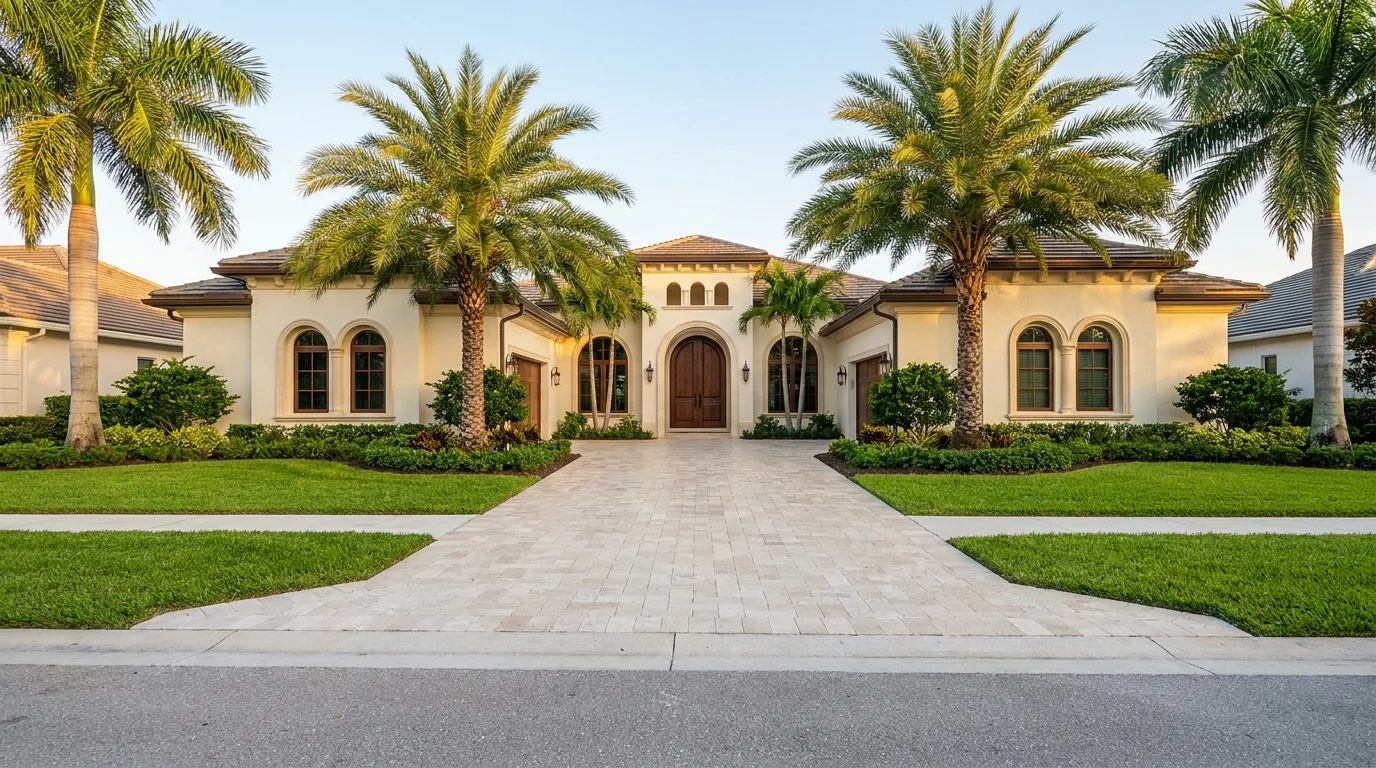
How much value do pavers add to a home? The honest short answer, drawn from national remodeling-impact averages and what we see on South Florida comps every month: pavers typically return around $1.00–$1.20 in appraised value per $1.00 spent, with paver driveways and pool decks landing at the top of that range and small ornamental walkways at the bottom. On a $650,000 Boca Raton home, that’s the difference between concrete-slab curb appeal and a driveway buyers photograph before they walk inside. Here’s the full picture from a licensed Florida contractor (CILB #U-22487) who installs and restores pavers across Palm Beach and Broward County — including the projects that don’t add value, and why.
The One-Line ROI Summary
Pavers, done right, typically pay back $1.00–$1.20 per $1.00 spent in appraised value. They also compress time on market and let a home stand out inside its comp band — two effects the raw appraisal number doesn’t fully capture. National remodeling-impact reporting (the kind published in NAR and Appraisal Institute-style guides) consistently places exterior hardscape and outdoor-living upgrades in the top tier of ROI improvements, ahead of most interior remodels. We treat those national averages as a floor for our South Florida market, not a ceiling — pool-deck and driveway pavers here read as expected finishes on any home above ~$500k, not as luxury add-ons.
Two things about that “$1.20 per $1” figure before we go further. First, it’s a range, not a promise — every appraisal is comp-driven and neighborhood-specific. Second, it assumes the install is proportionate, permitted, and well-maintained. Skip any of those and the ROI collapses fast; we get into why in section 6.
Appraisal Impact: Driveway Pavers vs. Concrete Slabs
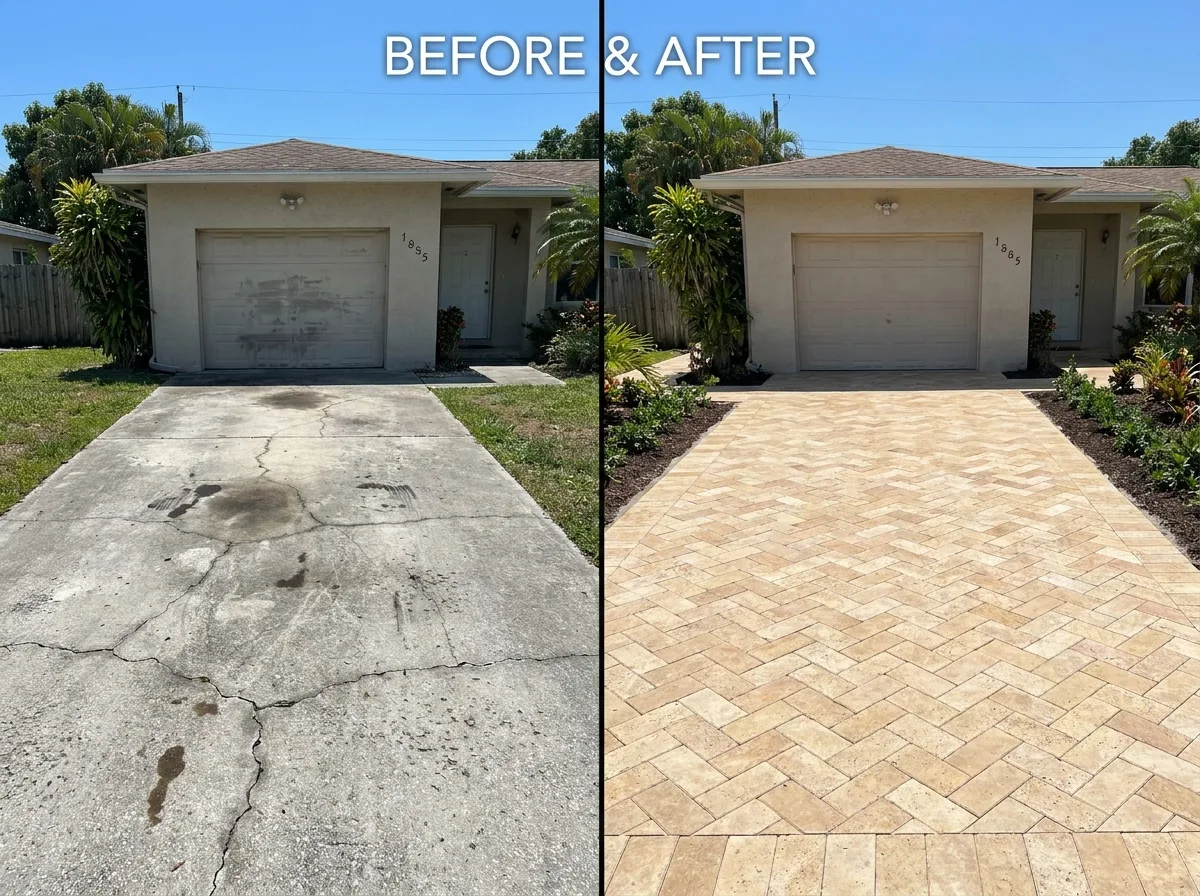
Appraisers assign more value to a paver driveway than to a plain concrete slab for four reasons, all defensible:
- Installed cost is higher. Pavers run $12–$32/sq ft installed; standard broom-finish concrete runs closer to $6–$12/sq ft. Cost basis flows into replacement-cost calculations.
- Lifespan is materially longer. Quality paver installs last 25–50+ years with periodic re-sanding and sealing. Concrete driveways in Florida typically show cracking, spalling, and salt/sun damage by year 20–30 and get replaced, not repaired.
- Repairability matters. A cracked concrete slab is a full-section tear-out. A stained or settled paver section is lifted, re-set, and reinstalled — the driveway keeps its useful life instead of restarting it. Appraisers treat repairable systems as retaining value longer.
- Curb appeal is measurable. Not vibes — measurable in list-to-sale days and photograph-count in MLS listings.
We’ve had appraisals where a fresh paver driveway on a home otherwise identical to the neighbor’s cracked-concrete driveway justified a $15,000–$25,000 higher opinion of value, particularly in Boca Raton, Delray Beach, and coastal Broward comps where paver hardscape reads as market-standard. That’s not universal — in modest inland neighborhoods where every home has plain concrete, the same install adds less. Comp-relative always beats absolute.
If you’re pricing the install itself before thinking about ROI, our cost to install pavers in South Florida guide walks through the $12–$32/sq ft range by paver type and project size.
Curb Appeal, Market Days, and Selling in South Florida
Curb appeal isn’t a warm-and-fuzzy factor — it’s a hard variable. Two identical Boca Raton homes on the same comp band typically sell at different velocities based on entrance presentation. A modern paver driveway plus a defined paver walkway to a front-door landing does three specific things:
- It fronts the listing photo. The first MLS photo is disproportionately the driveway-and-facade shot. A paver driveway makes that photo instantly more expensive-looking.
- It shortens showing-to-offer time. Homes within 5% of each other on comps tend to sell faster when hardscape is modern. In our market we routinely hear it back from agents in the “sold in the first weekend” language.
- It survives the drive-by test. Half of serious buyers do a drive-by before they book a showing. A cracked concrete driveway with oil stains gets crossed off the list before the interior ever gets seen.
None of this shows up as a line item on an appraisal — but it shows up on the sale price and on days-on-market, and both compound the paper appraisal lift.
ROI by Project Type: What Actually Pays Back
Not every paver project returns the same. Here’s the honest ranking as we see it on South Florida properties, with typical installed costs (from our own pricing and market comparables) and realistic appraisal / sale-price impacts. Ranges are wide on purpose — nobody who tells you a single number is being honest.
| Project | Typical size | Installed cost | Typical appraisal delta | Typical sale-price impact |
|---|---|---|---|---|
| Driveway pavers | 600–900 sq ft | $8,000–$25,000 | $8,000–$25,000 | Highest — front-of-listing effect |
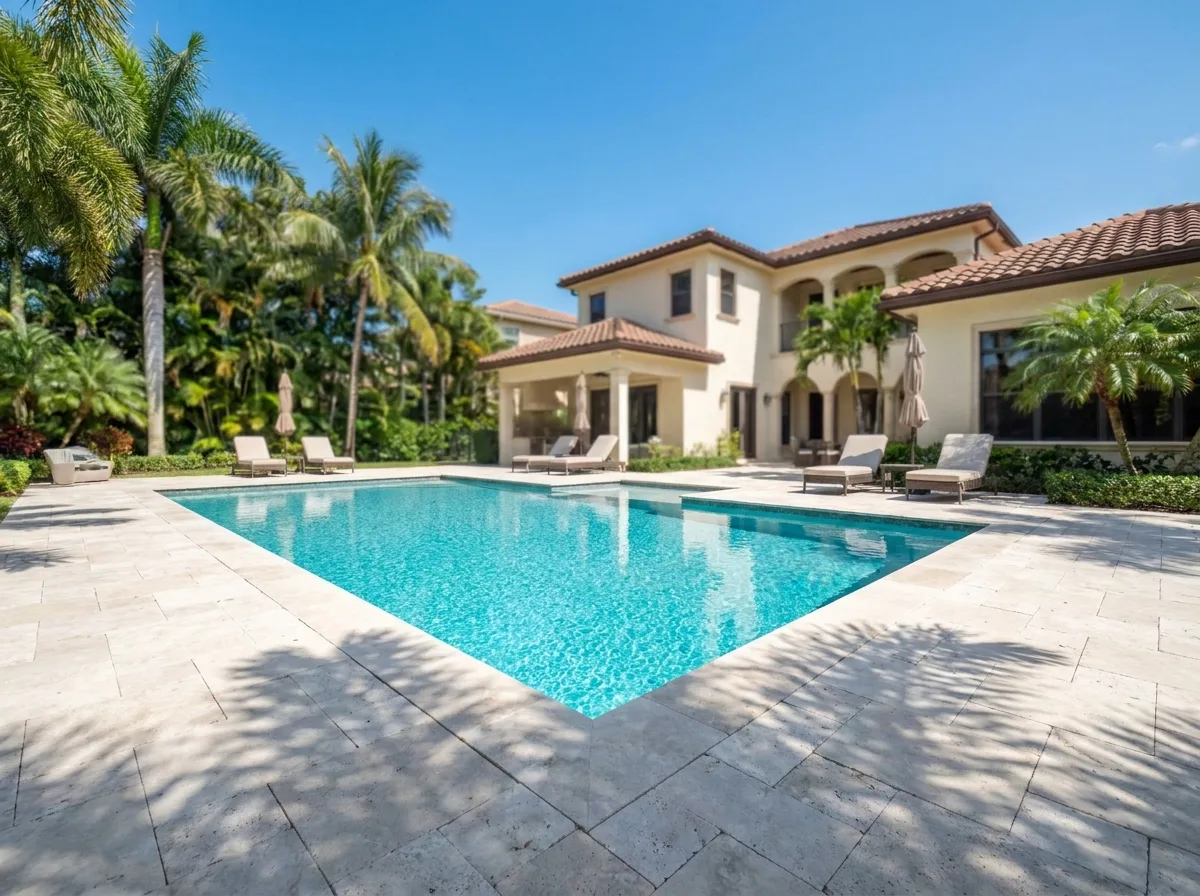
| Pool deck pavers | 500–1,000 sq ft | $8,000–$28,000 | $6,000–$22,000 | High — pool reads “finished” |
| Rear patio | 300–600 sq ft | $4,000–$16,000 | $3,500–$14,000 | Medium-high — outdoor-living factor |
| Walkway | 100–250 sq ft | $1,500–$6,500 | $1,000–$5,000 | Lower dollar, high perceived quality |
A few reads from that table:
- Driveways lead on absolute dollars. They’re the biggest surface, the most-seen surface, and the most-photographed. A well-installed driveway is the highest-leverage single project for a South Florida home.
- Pool decks over-deliver on perceived value. In a market where a large share of homes have pools, an updated pool deck stops your home from feeling half-finished. See our driveway pavers service page for what a proper install includes, then apply the same standard to pool decks.
- Walkways are the smallest-dollar but highest-quality-signal project. Buyers read a proper paver walkway as evidence the whole property is maintained. Under-invested for what it signals.
- Rear patios pay back the outdoor-living remodel. In warm-climate markets like ours, a paver patio expands functional square footage without a permit-heavy addition.
If you’re deciding between paver types — concrete vs. travertine vs. porcelain — cost is the visible variable but appraisal impact tracks perceived quality. Travertine and premium clay pavers appraise stronger than budget concrete pavers on comparable homes. Our travertine pavers cost guide breaks down the trade-offs.
Sell Soon vs. Stay Long: Which Project Fits Which Timeframe
The right paver project depends on when you’re selling. This is where most homeowners over- or under-invest.
Selling within 12 months. Do the highest-visibility, lowest-risk project: a proper paver driveway install or a full paver restoration if you already have pavers that are stained, sunken, or joint-washed. Skip elaborate custom patio work — you won’t recoup high customization at sale because buyers price to their own preferences. The goal is a clean, modern, well-maintained impression, not a bespoke outdoor room.
Selling in 1–3 years. Now is when the ROI math is friendliest — you have time to enjoy the install and it’s still fresh at sale. Full driveway + walkway packages, or pool deck resurfacing in pavers, both work well in this window. Budget for one round of sealing before you list (our paver sealing cost breakdown covers what quality sealing runs and why it protects appraised value).
Staying 5+ years. Optimize for what you’ll use, not what the next buyer will pay. Larger patios, custom pool-deck layouts, outdoor kitchens on paver bases — the appraisal lift matters less because you’re capturing years of curb appeal and functional outdoor space. Build to your own taste; the market catches up on the durable stuff (paver-over-concrete, wide walkways, unified drive-walk-patio design) regardless.
Staying indefinitely. ROI stops being the frame. The right question becomes: what does this land cost me over its lifespan? A quality paver install at $12–$32/sq ft installed, resealed at ~$1.10/sq ft every 2–3 years, is meaningfully cheaper across 25 years than replacing cracked concrete every 20.
What Paver Installations Don’t Add Value
We tell homeowners no about paver projects several times a month. These are the situations where the money doesn’t come back:
Over-improvement in a modest neighborhood. A $28,000 driveway install on a home comping at $325,000 in a neighborhood of $300–$375k homes with concrete driveways will not recoup at appraisal. Appraisers pull from local comps; unique high-end features get partial credit at best.
Unpermitted work where permits were required. Municipal rules in Palm Beach and Broward vary by scope — driveway aprons, work touching the right-of-way, or substantial impervious-surface changes often require permits. Unpermitted hardscape becomes a disclosure item at sale and can force costly retroactive permitting, or price concessions from the buyer.
Loud custom aesthetics. Multi-color mosaic patterns, dark chevron driveways, and heavily themed hardscape are polarizing. They photograph well on one buyer’s Pinterest board and eliminate the home from twenty other buyers’ shortlists. Neutral, well-scaled, unified paver work outperforms bold choices at resale every time.
Bad installation. Paver work with skipped base prep — insufficient compacted base, no bedding sand consistency, no proper edge restraints — starts settling within 12–24 months. Sinking pavers, ponding water, or lipping edges subtract value; a bad install is worse than the concrete it replaced. This is the single biggest reason we lead with base prep on every install.
Deferred maintenance. A five-year-old paver driveway with dead algae joints, sunken sections, and no visible sealing reads as neglected. It appraises at the low end of the range and knocks the whole home’s presentation. The install ROI assumes the pavers are maintained; when they aren’t, the delta shrinks to near zero.
HOA and Permit Factors That Protect (or Undermine) Value
South Florida homeownership includes two overlays that most out-of-market ROI advice ignores: HOA rules and municipal permitting. Both protect value when respected and destroy value when ignored.
HOA approval is a resale asset. Communities with architectural review boards typically require pre-approval for driveway pavers, front-yard walkways, and any exterior hardscape visible from the street. Written HOA approval on file is an asset at sale — it tells the next buyer the improvement is compliant and will not be a source of future violations. Skipping approval to save time creates a title-and-disclosure liability at closing.
Permits, where required, protect appraisal. Not every paver project needs a permit — a like-for-like patio replacement in a private backyard usually doesn’t. But driveway work that changes drainage, work in the public right-of-way, and any project touching impervious-surface calculations typically does. Permitted work shows up cleanly at appraisal and inspection; unpermitted work shows up as a comment that costs real money. When in doubt, permit — the fee is small; the disclosure risk isn’t.
Our install estimates always flag which parts of a project require permits and which don’t, and we pull the permits where we’re the installer of record. Working with a licensed contractor is not a formality; it’s what makes the paperwork side of the ROI hold up.
Case Pattern: The $18k Driveway on a $650k Boca Raton Home
Illustrative, not a specific project — but this is the shape of what we see routinely on South Florida homes in the $500k–$800k band:
- Starting condition: original poured-concrete driveway, ~850 sq ft, 22 years old, cracked in three sections, oil-stained near the garage, general grey-yellow discoloration. Home otherwise well-maintained; interior recently updated.
- Install scope: full tear-out and haul-away, proper base prep (compacted crushed stone base, screeded bedding sand, cut-in edge restraints), quality concrete pavers in a neutral warm-grey tone, running-bond pattern, sealed on completion.
- Installed cost: ~$18,000 (roughly $21/sq ft installed — mid-market for this quality tier).
- Appraisal impact on sale within 24 months: typically $14,000–$20,000 higher opinion of value on a well-comped home, per the local comparable set of paver-driveway homes in the community.
- Sale-side effect: listing photographed better, more first-weekend showings, faster offer velocity than the comps with concrete driveways. This part is not on the appraisal — it shows up in days-on-market and in the final accepted offer relative to list.
The range varies by neighborhood, by paver quality, and by how well the rest of the home is presented. Homes that pair the driveway install with a walkway upgrade and clean landscaping typically see the higher end of the appraisal band. Homes that install a beautiful driveway on a house with a tired front door and dying grass leave money on the table — the driveway becomes an outlier the buyer’s eye can’t reconcile.
The ROI Framework: How Pavers Increase Home Value in Real-Estate Terms
When appraisers, agents, and potential buyers talk about how much value pavers add to a home, they use a specific vocabulary that maps onto the numbers above. Knowing the terms makes it easier to talk about your project in the same language as the market:
- Property value / market value / resale value. These are the appraised or listing figures that pavers move directly. A quality paver patio, paver driveway, or pool deck can increase your home value by a range that mirrors the installed cost — that’s the “$1.00–$1.20 per $1.00 spent” pattern in action.
- Return on investment (ROI). The percentage of installed cost recovered when you sell your home. Pavers routinely return 80–120% of installed cost, higher than most interior remodels of similar dollar size — one of the reasons pavers can increase real value more efficiently than an equivalent kitchen or bathroom refresh.
- Perceived value / curb appeal. Not on the appraisal line, but decisive on the offer line. A patio or driveway laid in travertine pavers, natural stone, or a well-designed paver walkway makes a home apart from others in the same block — many home buyers form their offer within seconds of seeing the driveway.
- Outdoor living space. Rear paver patios and patio or walkway additions get counted as usable square footage in the buyer’s mental model, even when they’re not in the interior square-foot figure. That’s why paver patios can increase perceived home size at a fraction of the cost of an addition.
- Permeable paver systems. In HOAs or municipalities that require stormwater compliance, a permeable paver driveway or walkway can pay back twice — as hardscape value and as a code-compliance asset. Value permeable pavers where the local code accepts them for pervious-surface credit.
Together, these are how a well-designed paver installation converts into dollars: appraised property value, faster sale (market value in practice), higher perceived value at showing, and lasting outdoor living-space utility.
The Bottom Line
Pavers add value to a South Florida home in three overlapping ways: appraised value (typically $1.00–$1.20 back per $1 spent), sale velocity (faster offers, fewer days on market), and durability savings over time (25–50+ year lifespan vs. 20–30 for concrete, with sealing at ~$1.10/sq ft every 2–3 years to protect the investment). The projects that pay back the most reliably are driveways and pool decks; the ones that pay back the least are over-improvements, unpermitted work, and loud custom aesthetics buyers won’t share.
The single most important variable — bigger than paver type, bigger than pattern, bigger than sealer choice — is install quality. A properly base-prepped, edge-restrained, sealed paver driveway holds its value for decades. A skipped-prep discount install starts subtracting value in year two.
If you’re in Palm Beach or Broward County and want an honest read on which paver project actually makes sense on your home — including a straight answer if the ROI doesn’t justify the spend — our paver installation service covers the full scope, with licensed work (CILB #U-22487), 45 verified Google reviews, and a free on-site assessment that includes the number you’re actually going to recoup.